
2025.12.18

TCS AI Studio, a co-creation hub and one-stop provider of AI journey planning and implementation

TCS Japan’s TCS AI Studio is a shared hub that drives business transformation for client companies by offering comprehensive support for AI implementation.
Tata Consultancy Services Japan Limited (TCS Japan) has a team of AI professionals known as the AI Center of Excellence (AI CoE), which delivers strategic approaches for client companies to leverage generative AI. The AI CoE first provides consultation on AI services, supports their implementation, and accelerates the client companies’ business transformation.
When undertaking AI-based digital transformation (DX), clients must remove barriers that hinder AI adoption and implementation, and take appropriate measures to maximize earnings and productivity and reduce costs. They also need to make adequate investments to operate AI and to acquire existing know-how while striving to overcome challenges. To support clients in these efforts, the TCS AI Studio functions as a co-creation hub where the AI CoE provides a one-stop service for envisioning, defining, and executing their AI journey.
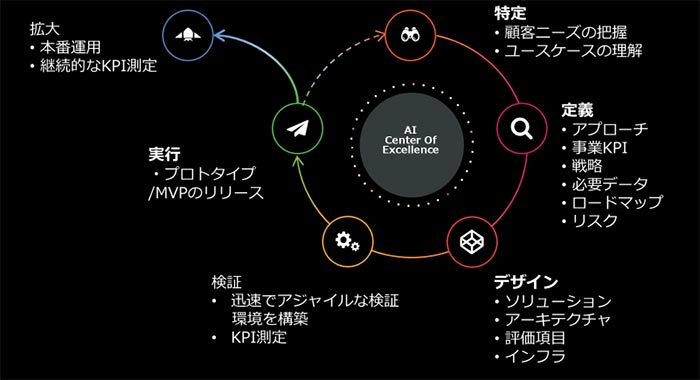
AI Center of Excellence (AI CoE)
TCS Japan is composed of three divisions: Consulting; Service Delivery, which is responsible for app development and maintenance, core systems, networks, IoT, security, and more; and Research and Development. The AI CoE, which spans all divisions, assumes the role of providing AI knowledge and solutions across TCS Japan as a whole. Ryunosuke Kunisawa, an AI Lab data scientist with the AI CoE, explained as follows.
“The TCS AI Studio was created as a space for the AI CoE to conduct interviews and give presentations with the aim of exploring issues and measures that need to be addressed when delivering solutions to clients. First, the AI CoE clarifies the client’s needs and identifies requirements to be fulfilled by each Service Delivery department while collaborating with the R&D team in India. Furthermore, AI is not something that clients can easily understand. At the TCS AI Studio, we also help clients gain hands-on understanding of how the system works and the impact of its adoption, which eventually fosters deeper mutual understanding and trust.”
While AI is increasingly being used for internal operations, AI implementation for customer service is still in its exploratory phase
At the TCS AI Studio, AI CoE members engage in co-creation with clients. As intermediaries that connect project targets to frontline staff, the members develop a roadmap from “As-Is” to “To-Be” and clarify the requirements. Specifically, AI CoE members showcase the functions of AI and share success stories, followed by an AI Journey Initiation Workshop where they identify issues and set key performance indicators (KPIs). Subsequently, they hold an In-depth Workshop and offer In-depth Consulting, followed by trial operation before moving on to full-scale operation.
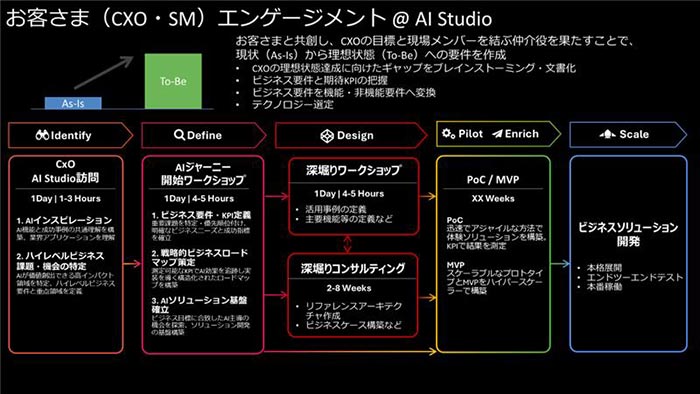
The time required for the whole process varies depending on the solution, but many clients are eager to install the new system as soon as possible. Clients span a broad range of sectors, including manufacturing, insurance, banking, airlines, and construction.
So, what are their actual needs?
Mr. Kunisawa explained, “Currently, clients are most interested in using AI to quickly locate necessary information within massive volumes of internal documents. There is also a wide range of other needs, such as digitalizing the expertise of experienced professionals for everyone to use; safely operating high-precision AI across the company or department; continuously running predictive models for business purposes; and enhancing system management efficiency using AI.”
Currently, there is a high overall need for AI in business operations, while the use of AI for corporate reform and innovation remains limited.
Muttharasan Muthukrishnan, an AI go-to-market technical architect of the AI CoE team, explained, “The momentum to expand AI use is strong in Japan, but its implementation is still fledgling. Meanwhile, in English-speaking countries, learning generative AI is easy, given the wealth of global datasets available. Driven by the high precision and ease of accumulating expertise, AI development in such countries is accelerating. In contrast, there is limited information available in Japanese, so new data is required for translation and learning. “This is why AI development in Japanese is progressing more slowly than in English. AI in China is advancing in its own unique way, but India, being an English-language nation, is apparently achieving AI growth that aligns with global standards.”
Humans and AI complementarity
How will AI evolve going forward? Mr. Kunisawa explained, “Generative AI’s performance is still comparable to that of a first- or second-year employee, fresh out of college. It will take about four more years before AI becomes a fully capable workplace member who can be trusted with various tasks.”
He continued, “As AI technologies develop at a tremendous speed, we need to presume that their functions will be updated. Getting a head start enables clients to accumulate expertise, so keeping up with the speed of development is meaningful. However, not everyone has to be a frontrunner. Although getting started is important, it may be more practical and wise to proceed while observing how other companies move.”
The AICoE at the TCS AI Studio has a great deal to offer in this respect due to its extensive experience and expertise gained from working with numerous clients. This enables the team to share best practices while drawing from its knowledge of common issues faced during implementation and failure cases.
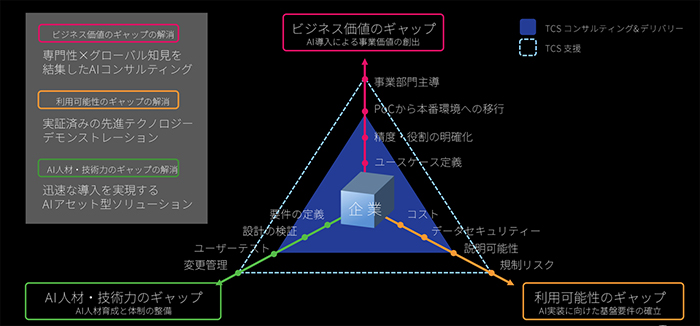
TCS Japan resolves challenges in AI implementation across three dimensions.
Mr. Muthukrishnan explained, “Concerns about data security have been rising lately. It is crucial to ensure safety when AI handles highly confidential data. Controlling undesired output is another challenge that must be addressed. AI evolves by continuously integrating new data, so there are always new concerns that must be dealt with.”
Perhaps ordinary business people would be better off focusing on “utilizing” professional and tacit knowledge while continuing to use AI. There is no way to beat AI in acquiring knowledge, so the ability to use knowledge effectively will become increasingly important. In a few years, it is expected that AI agents will be able to plan and execute tasks autonomously to achieve goals.
“We are heading towards an era where people and AI will work together, complementing each other's abilities. Eventually, there will be new jobs that use AI to support how humans work,” said Mr. Muthukrishnan.
Finally, Mr. Kunisawa said,
“You don’t have to know much about AI. Let us help you learn about the current state of AI. We will always be waiting for you at the TCS AI Studio.”
INTERVIEWEES

RYUNOSUKE KUNISAWA
Data scientist
AI Lab
AI Center of Excellence

MUTTHARASAN MUTHUKRISHNAN
Technical architect
AI go-to-market
AI Center of Excellence
Tata Consultancy Services Japan Limited
10F Azabudai Hills Mori JP Tower, 1-3-1 Azabudai, Minato-ku, Tokyo
The company's Indian head office was founded in 1968. TCS is a part of the Tata Group, one of the world's largest multinational conglomerates. It employs highly skilled professionals in 55 countries worldwide and operates 202 service delivery centers. TCS Japan was established in 2014 as a joint venture between TCS and Mitsubishi Corporation. With consulting as its core business, the company develops comprehensive services and solutions in the fields of business, technology, and engineering.