
2026.01.22

Guidebook on societal issues, new tech, and business ideas
Mitsubishi Research Institute publishes 2025 edition of Listings of Societal Issues
The Listings of Societal Issues first took form amid efforts by Mitsubishi Research Institute, Inc. to identify societal issues to be considered by its Initiative for Co-Creating the Future. Today, the firm shares the Listings across industry, government, and academia for free to serve as a foundation for solving the world’s challenges.
Mitsubishi Research Institute, Inc. (MRI) began publishing Resolving Societal Issues through Innovation: Listings of Societal Issues in 2017. The book has encompassed six areas: Energy and Environment, Water and Food, Mobility, Disaster Prevention and Infrastructure, Wellness, and Education and Human Resource Development. The 2025 edition brought a few new updates: the Water and Food area was expanded to encompass Food and Agriculture, Disaster Prevention and Infrastructure transformed into Resilience, and a seventh domain—DE&I, or diversity, equity, and inclusion—was added. This broadens the scope of the Listings to seven domains and 30 specific themes.
By redefining the areas and themes, MRI aims to encourage companies to take on the challenge of resolving societal issues.
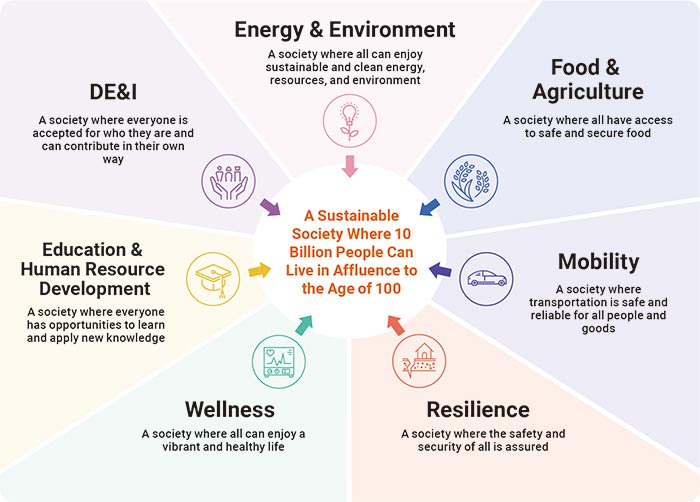
The seven areas in Mitsubishi Research Institute’s Listings of Societal Issues and the potential that resolving issues in those areas can bring (Source: Mitsubishi Research Institute, Inc.)
The Listings compiles societal issues that have the potential to be resolved through innovation and business, and the 2025 edition reorganizes the issue areas from three perspectives: earth, society, and people. Taking into account recent social conditions, the specific themes of focus for each area were reconsidered and new ones were added. The result: seven areas and 30 themes.
A visual-abstract approach has also been added to better express the situation surrounding each issue area from a macro level perspective. These illustrations cover three important aspects: the core societal problems, the specific societal issues that must be addressed, and clues to solutions. Cyberspace is also recognized as a key area of rapidly-growing significance, and the Listings includes exhibits on cybersecurity and ELSI (ethical, legal, and social implications). Shintaro Yamaki, chief researcher at the company, explains:
“Comprehensive listings of societal issues are surprisingly scarce. The Listings is not written for specialists; we want it to be put to practical use. We wrote it in such a way that your average reader can pick it up and dive right into any part and learn about real challenges facing society.”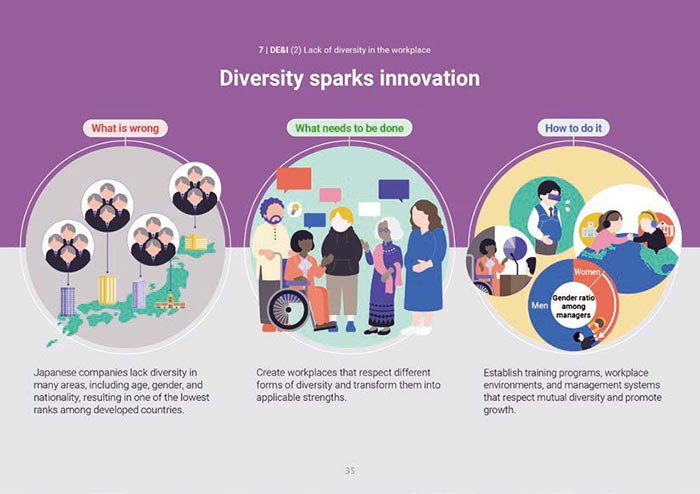
The visual abstract for the DE&I area (Source: Mitsubishi Research Institute, Inc.)
The goal is to achieve a sustainable society where 10 billion thrive into their 100s
The Listings of Societal Issues has been reviewed and revised annually since its first publication in 2017 to capture the shifting landscape of societal problems, taking into account domestic and international social, economic, and technological developments. Government agencies, corporations, schools, and other organizations use the Listings as a reference when exploring new ventures to help resolve societal issues or when examining challenges facing society.
Mitsubishi Research Institute (MRI) runs the Initiative for Co-Creating the Future (ICF), a platform that promotes co-creation activities to resolve societal issues through open innovation and business. The Listings of Societal Issues identifies, analyzes, organizes, and explains critical societal issues, which also form the starting point of ICF's activities.
"In the beginning, the Listings sole purpose was to identify societal issues objectively and share them with everyone," says Yamaki. "Today, it has gained increasing recognition among government agencies and corporations, and some businesses are pursing themes based on the Listings."
ICF was launched in April 2021 through the merger of the Platinum Society Research Association, established by MRI in 2010, and the Innovation Network for Co-creating the Future (INCF), established by MRI in 2017. As of October 2025, 633 organizations have joined ICF, including corporations, startups, local governments, university research institutions, and government agencies. Membership consists of co-creation members and general members.
The goal of ICF is to help foster a sustainable society in which 10 billion people thrive into their 100s. It leverages its diverse membership in the spirit of equal partnership to foster a collaborative ecosystem among industry, academia, and government that offers a platform for the integration of knowledge and the co-creation of value. Its primary activities are planning and operating programs that cover the entire process of resolving societal issues, from identifying issues to business creation, with an emphasis on integrity.
ICF activities center on workshops and projects and include discussions of societal issues, business acceleration programs, business co-creation, collaborative research groups, and the real-world implementation of solutions.
"Even if a company or university possesses useful technology, it’s not guaranteed that it will reach society at large," says Ayane Watanabe, a consultant at Mitsubishi Research Institute. "The challenge lies in nurturing the seeds of innovation that already exist into viable businesses. We look to help create an environment conducive to growing these seeds and implementing them in society."
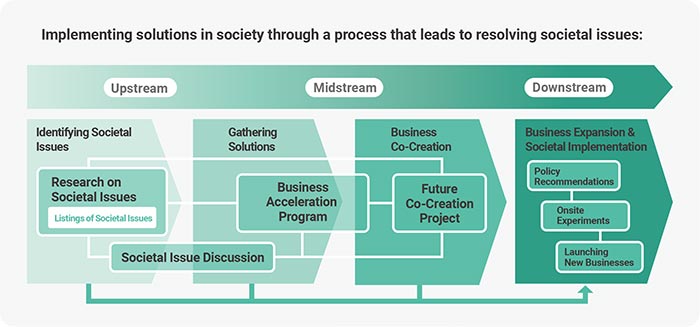
Overview of ICF activities (Source: Mitsubishi Research Institute, Inc.)
Hopes for the Listings:
Making issues more understandable and relatable
Since its start, the Listings of Societal Issues has put into practice a methodology for analyzing and structuring diverse societal problems as well as comprehensive information on specific societal issues. The Listings has done so with a global perspective since its second year—2018. In subsequent years, it has incorporated technological and regulatory trends as well as societal development that could serve as a starting point for resolving issues. More recently, the Listings has been updated to address new societal issues, factoring in the impacts of the covid pandemic and the Russian invasion of Ukraine. To address future societal issues, the Listings employs a comprehensive approach that incorporates backcasting.
"Mitsubishi Research Institute has traditionally undertaken many government projects and possesses expertise in policy and regulatory trends that are relevant in creating the Listings," explains Watanabe. "Furthermore, because our discussions with clients are by nature directly linked to societal issues, the Listings is well aligned with the needs society."
For instance, in the 30 themes and seven domains of the 2025 edition, the Energy and Environment issue area identifies “Ensuring flexibility in electricity supply and demand management” as the challenge in response to the issue “Accelerated introduction of renewable energy leads to unstable power supply.” In the case of the Food and Agriculture area, the problem of “Insufficient food production systems to accommodate future ESG requirements” will be met by the issue of “Addressing environmental and social risks in the food production supply chain.” The newly added DE&I issue area tackles the “Lack of workforce diversity” by addressing the challenge of “Creating an environment that leverages individuals regardless of personal attribution.” These can offer companies insights for finding new business opportunities and fostering innovation.
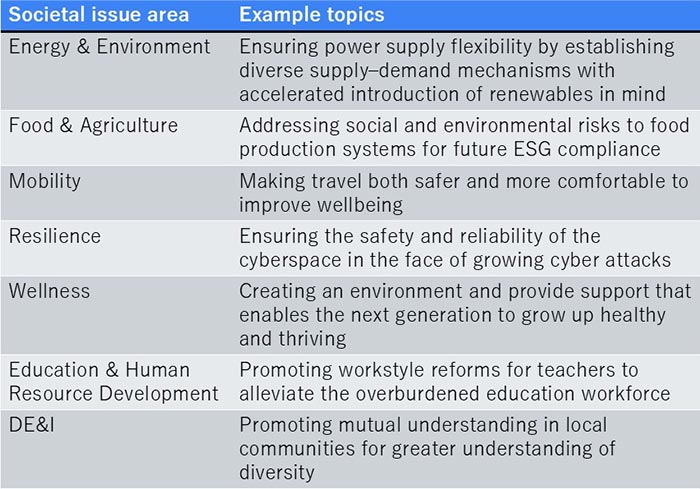
A sampling of new themes in each issue area (Source: Mitsubishi Research Institute, Inc.)
This year marks the fifth anniversary of ICF's integration. Its diverse membership is its defining feature, allowing it to analyze challenges from multiple angles and offer a wide range of solutions. Global progress in resolving societal issues has been a seesaw struggle, with many issues remaining unresolved and others accumulating. ICF will continue to update its Listing of Societal Issues.
Watanabe concludes: “Non-members can also download the list. Since we've created it in collaboration with many experts, it's interesting to read, and I have learned a lot. I hope people will use it to grasp today's social needs when considering business strategies or new ventures."
“The Listings of Societal Issues only offers an entrance; I hope it serves as a starting point for each reader to think about what they can do and what must be done. And I hope it will help make societal issues more relatable. There I believe the seeds of new solutions lie,” adds Yamaki.
INTERVIEWEES
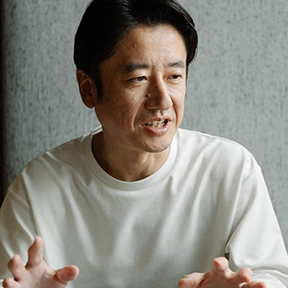
SHINTARO YAMAKI
Chief Researcher
Future Co-Creation Group
Customer Relations Division

AYANE WATANABE
Consultant
Future Co-Creation Group
Customer Relations Division
and Innovation Strategy Consulting Group
Business Consulting Division
Mitsubishi Research Institute, Inc.
10-3 Nagatacho 2-Chome, Chiyoda-ku, Tokyo
Mitsubishi Research Institute is one of Japan’s foremost think tanks. For over 50 years, it has provided the public and private sectors with research and consulting services in fields spanning the environment, energy, healthcare, human resources, and digital transformation. This is accompanied by policy recommendations and the real-world application of solutions. Mitsubishi Research Institute will continue to envision the future, resolve societal issues, and lead change to build a sustainable and prosperous world. For more information, please visit: www.mri.co.jp/en/