
2026.01.22

To Support Local Livelihoods—Success Factors and Future Prospects of Lawson’s Community-Based Convenience Stores
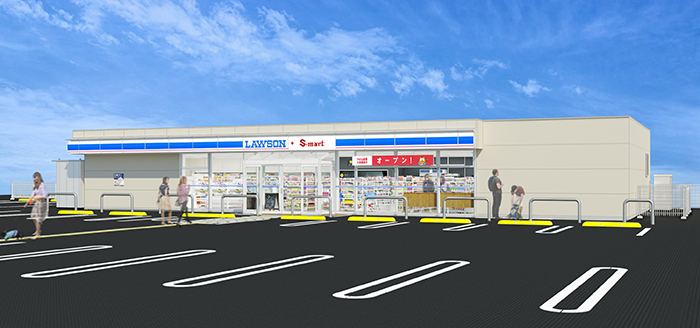
Lawson Tanpi Yazu-cho store (illustration), located in Tottori Prefecture, procures fresh food in cooperation with the local supermarket S-mart supermarket
In recent years, supermarkets have been closing in many regions partly due to Japan’s aging and declining population. As a result, mainly elderly consumers are finding it difficult to buy food. According to the Policy Research Institute, Ministry of Agriculture, Forestry and Fisheries (PRIMAFF), the population with food access difficulties as of 2020—defined as those aged 65 or older who live more than 500 meters away from the nearest store and cannot use a car—amounts to an estimated 9.04 million.
In these regions, Lawson is promoting the launch of community-based convenience stores, an initiative that won the Excellence Award in the New Distribution Business Contest for Supporting Shoppers in Difficult-to-Shop Areas organized by the Ministry of Economy, Trade and Industry (METI) in February 2025. Tadao Takahashi, Executive Officer and Head of the Development Division, previously oversaw operations as the regional president for the Chugoku-Shikoku area. Currently in charge of store development, including community-based convenience stores, he states the following:
”Convenience stores can operate in areas with a small customer base compared to that necessary for a supermarket, and they can be run by few staff members. They also have the unique strength of a nationwide logistics network. We believe that, by conducting a thorough market area analysis and restructuring the product lineup accordingly, we can launch community-based convenience stores that are linked with local governments, companies, and residents even in areas where we could not open stores before, and we are advancing these initiatives.”
Coexisting with local supermarkets to create happiness for everyone
Community-based convenience stores are sometimes built on the sites of closed local supermarkets, at the request of local communities. One such example is Lawson Tanpi Yazu-cho store, which opened in 2024. The only supermarket in this region closed in 2023, making it difficult for the residents to shop. Lawson opened its store on the site in collaboration with the town. As is the case with regular Lawson stores, it carries about 3,500 items, in addition to fresh food such as vegetables, meat, and fish. It also offers services such as a postal drop box, the issuance of residence certificates, and ticketing, as with Lawson stores nationwide.
“There are cases where a convenience store and a local supermarket open a hybrid store, with the supermarket becoming a franchisee. These stores sell fresh food and often procure and sell locally grown ingredients and food products, thereby playing a role as a hub that promotes local specialty products. We operate these stores with the hope of coexisting with local communities by encouraging them to use Lawson stores, instead of depriving them of their opportunities in the existing markets,” explains Takahashi.
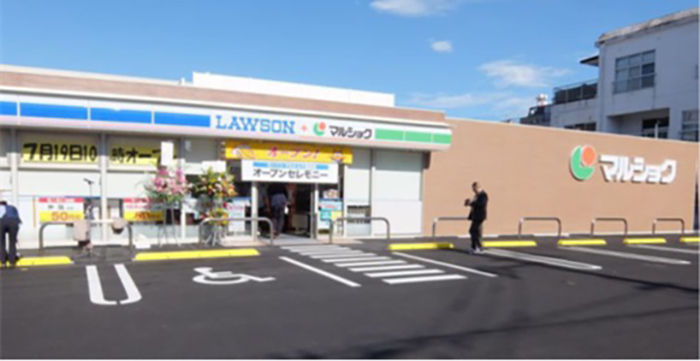
Lawson + Marushoku Nagahama store in Oita Prefecture, opened in 2024. This hybrid store is run by the local supermarket’s operating company as the franchisee.
To promote community engagement, Lawson has introduced an area-company system, which divides its nationwide operations into eight regions. Each area-company store development representative develops store-opening plans by gathering detailed information on local residents’ concerns, such as “This region has no stores that sell fresh food,” or “We have no service counter for obtaining residence certificates.” “Opening stores that meet local needs will bring joy to more people. We believe that this will stimulate demand and help expand our business as well,” states Takahashi.
How can Lawson open stores about 240 km from the nearest logistics base?
One issue in opening stores in depopulated areas is ensuring a stable product supply, as these locations are far from logistics bases. Lawson’s Machikado Chubo in-store kitchen makes it possible to prepare hot meals, sandwiches, and other fresh foods on-site. It is one of the company’s unique strengths and provides a solution to this issue.
“Community-based convenience stores can provide rice balls and boxed meals prepared in-store using the Machikado Chubo kitchen even when bad weather or disasters disrupt logistics, as long as they have stocks of rice and frozen ingredients for the kitchen. Shelf-stable products and drinks are also stored in large warehouses. In addition, these stores have enhanced storage facilities for frozen food,” explains Takahashi.
For example, Lawson Wakkanai Sakae 5-chome store and Wakkanai Komadori 5-chome store, both opened in 2023, are located quite far from their nearest logistics bases—about 240 km away. At these stores, the Machikado Chubo in-store kitchen is ready to prepare products in the event of storms or other conditions that may disrupt deliveries.
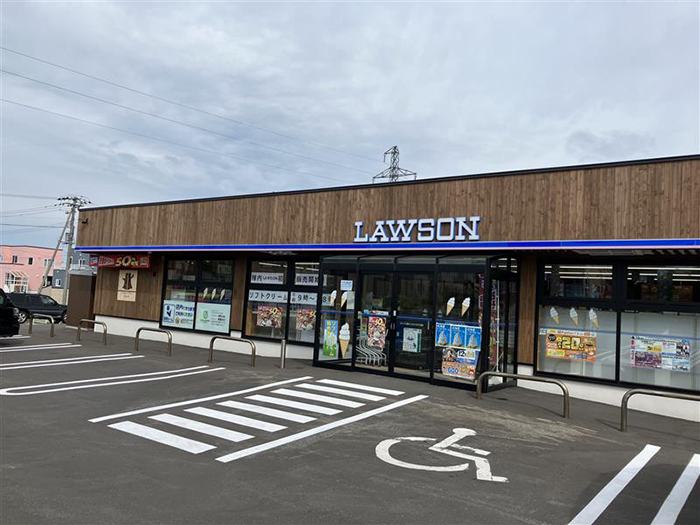
Lawson Wakkanai Sakae 5-chome and Wakkanai Komadori 5-chome stores in Hokkaido, designed to continue operating even when logistics are disrupted.
Labor shortage is another issue in depopulated areas. Lawson is advancing the use of avatar staff and other AI-based labor-saving measures to address this issue. However, at present, local residents are actively working at community-based convenience stores, and securing a workforce has not been much of an issue. On the contrary, these stores appear to be helping create job opportunities.
That said, Lawson is opening stores in areas where supermarkets have closed. Doe this raise any concern about their business success? Takahashi confidently responds, “There is no need to worry.”
“We are reducing initial investment costs by making use of existing buildings and other facilities. Recently, local governments have been approaching us with inquiries about whether we can use closed school sites or if we could review potential locations for new stores,” elaborates Takahashi.
Opening stores on remote islands and expanding community-based convenience stores
In 2025, Lawson Osaki Kamijima Higashino store opened on a remote island in the Seto Inland Sea in Hiroshima Prefecture. In preparation for ferry disruptions, it is equipped with a large warehouse to secure sufficient inventory. Being the first 24-hour convenience store on the island, it attracted crowds of residents lining up on opening day, and it was also reported in the news. Local people showed enthusiasm, commenting, “I’m touched,” and children excitedly saying, “It feels like being in the city,” which the owner and the headquarters staff found deeply moving.
“The increase in elderly single-person and two-person households is an issue shared across Japan. Under Lawson’s Group philosophy of Creating Happiness and Harmony in Our Communities, we will continue to further refine our community-based convenience stores. Within the Mitsubishi Group network, if you have any inquiries or information regarding new store openings, please contact us,” states Takahashi.
INTERVIEWEES

Tadao Takahashi
Executive Officer, Head of the Development Division
Lawson, Inc.
11-2, Osaki 1-chome, Shinagawa-ku, Tokyo
Established in 1975, Lawson opened its first store in Toyonaka City, Osaka, and currently operates about 22,000 stores in Japan and overseas. Upholding the Group philosophy of Creating Happiness and Harmony in Our Communities, the company commits to superior taste, human kindness, and environmental (machi) friendliness. It strives to become the “hub of refreshment in every community,” where every visitor can feel relaxed and refreshed.