
2026.02.19

Massively Popular Return Gift Choices for Hometown Tax Donations!
Choosing Mitsubishi Paper Mills’ Facial Tissue Brands “nacre” and “rucre” Helps You to Take the First Step toward Ethical Consumption
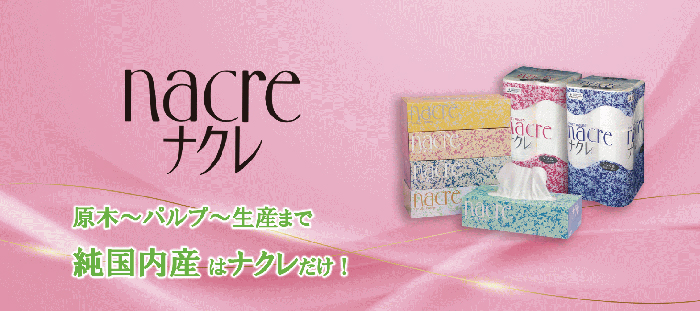
Mitsubishi Paper Mills’ household paper brand “nacre” has long topped the rankings of domestically manufactured box tissue sales in the Tohoku region. The company began manufacturing nacre facial tissues in 1997 at its Kitakami Mill in Iwate Prefecture, and is currently selling the branded products across the Tohoku region and in some areas of the Kanto region. We interviewed Mr. Hirohisa Yamamoto, Mr. Yasuhiro Kawamata, and Ms. Natsumi Okazaki, who are in charge of marketing household paper products under the nacre and other brands, about Mitsubishi Paper Mills' sustainability initiatives.
The nacre brand boasts premium quality: Tissues using 100% domestic wood pulp, which are rarely found on the market
Nacre products are very familiar to consumers in the Tohoku region. Users highly evaluate their quality, praising the tissues as large, soft and easy to use, and gentle on the skin. Many households have used these tissues as their household essential for generations, from grandparents to grandchildren.
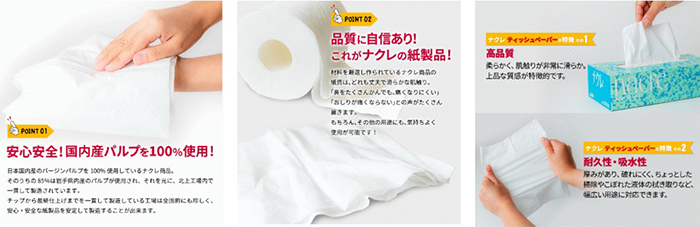
While most tissues marketed as domestic products use recycled paper or foreign wood pulp as raw materials, nacre distinguishes itself from these domestically manufactured products in that it uses 100% domestic virgin wood pulp.
”Nacre products are purely domestic products. We procure 70 percent of the raw material wood from Iwate Prefecture, and the remaining 30 percent from neighboring prefectures in the Tohoku region. All of the local wood is processed into pulp at our Kitakami Mill. The use of domestic wood contributes to the product’s premium quality. Our tissues are exceptionally soft, pure white, large-sized, and thick, as well as comfortable and smooth to the touch. While compact tissues are becoming more common today, nacre tissues have maintained their traditional size, and are actually the largest among box tissues on the market,” said Mr. Yamamoto.
Nacre products are offered as return gifts for hometown tax donation programs of Iwate Prefecture (the prefectural government), Kitakami City, Kanegasaki Town, and Otsuchi Town (all three are in Iwate Prefecture). The products rank high in popularity and have gained favor with many users. In recent years, we have received numerous inquiries from across Japan, asking, “I heard that nacre is a high-quality product and I want to try it,” and “How can I purchase it?”
”For people who live outside the distribution areas, we suggest using the hometown tax programs. We hope that people across the country will experience the size and softness for themselves,” explained Mr. Kawamata.

Protecting healthy forests by using local timber
Kitakami Mill, which manufactures nacre products, began operations in 1965 as a production facility for the former Shirakawa Pulp Industries, a pulp manufacturing company. Upon the merger of Mitsubishi Paper Mills with Shirakawa Pulp Industries in 1966, the site became Mitsubishi Paper Mills’ Kitakami Mill. The mill currently operates as a long-established manufacturing facility with a 60-year history.
”Papermaking companies traditionally used wood from forests in Japan to make paper, and they therefore often established factories near forests in inland areas. Kitakami Mill is also located in an environment surrounded by rich nature. However, during the high economic growth period and thereafter, paper consumption increased, and so Japanese timber alone could no longer meet the demand, which led to importing low-cost timber from overseas. Consequently, paper mills moved to coastal areas, resulting in a decline in inland factories. Meanwhile, the underutilization of domestic timber has become a significant issue in recent years, and the national government has responded by promoting the use of domestic timber. Against this backdrop, we have consistently been using local timber and producing products at our inland facility at Kitakami Mill,” stated Ms. Okazaki.
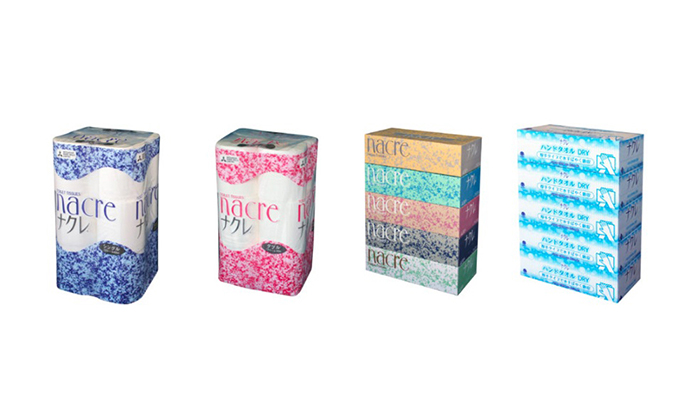
The brand name ”nacre” means “pearl-like luster” in French. True to its name, nacre products derive their white, smooth paper quality from domestic timber. The brand’s lineup includes box tissues, toilet rolls, hand towels, and disinfectant wet wipes.
If forests are left unmanaged without proper thinning, they become overcrowded, depriving trees of sunlight and nutrients, eventually leading to forest decline. By utilizing domestic timber, nacre plays a role in maintaining healthy forest cycles.
Nacre also plays a role in reducing CO2 emissions. Mr. Yamamoto explained, “Nacre's wood raw material source and its manufacturing plant are located close together, and its primary product distribution area is within the Tohoku region. We believe that this contributes to reducing CO2 emissions during transportation of the raw materials and finished products.”
Kitakami City’s forests and urban areas are in close proximity, making it susceptible to landslides and other forest-related hazards if forest maintenance is neglected. To address these challenges, Mitsubishi Paper Mills collaborates with local governments on forest preservation.

The rucre brand bearing the international environmental FSC mark
Forest Stewardship Council (FSC) certification is a system that ensures that products made from forest resources sourced from responsibly managed forests in a way that is beneficial to the environment, society, and economy, or other low-risk forest products, are labeled with the FSC mark and delivered to consumers. Choosing products bearing the FSC mark contributes to forest conservation. In 2001, Mitsubishi Paper Mills’ Hachinohe Mill (Aomori Prefecture) became the first paper manufacturer in Japan to obtain FSC certification, and commenced production of certified products such as printing paper bearing the FSC mark. In 2019, the company launched the "rucre" brand to offer FSC-certified products, and began producing FSC-certified rucre tissues and toilet paper.
FSC® C021528
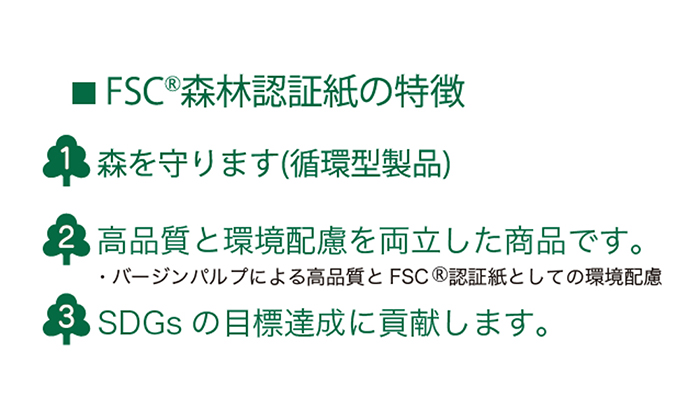
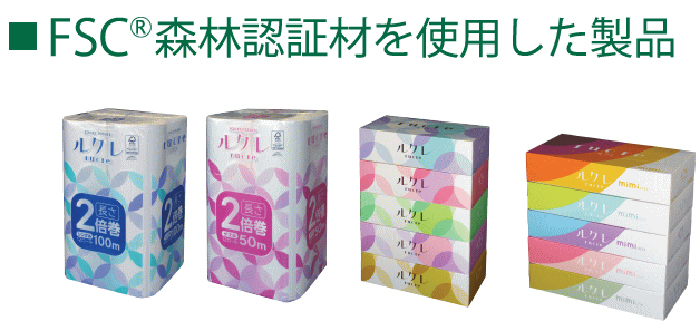
“In 2019, we commenced production and sales of household paper products under the ‘rucre’ brand. We are currently marketing the brand with the goal of distributing our FSC-certified products nationwide by leveraging programs like hometown tax donations, as these products can contribute to forest conservation through paper usage,” said Mr. Yamamoto. “Mitsubishi Oji Paper Sales, a distributor for Mitsubishi Paper Mills, has established the website ‘FSC Support Project’ (https://shitte-erabo.net/), which introduces various FSC-certified products to promote wider awareness of the FSC certification system,” added Mr. Kawamata.
“Mitsubishi Paper Mills engages in paper manufacturing by processing wood and other plant fibers into pulp. We have a strong desire to practice sustainable paper production while maintaining rich forests and making effective use of wood. We intend to continue prioritizing the use of domestic timber and FSC-certified wood,” highlighted Ms. Okazaki.
Amid persistent inflation, it has become increasingly difficult to choose products based on quality and environmental considerations over price. However, we are also in an era calling for a shift toward ethical consumption, or consumption behavior that considers not only short-term profits but also people, society, and the environment, including regional revitalization and employment, from a long-term perspective. Choosing nacre, which is dedicated to using 100% domestic wood pulp, and FSC-certified rucre can be a powerful first step in ethical consumption.
Have you ever considered where the raw materials for the tissues you use every day come from and where they are manufactured? Nacre and rucre products are used at the Mitsubishi Club and Shonan Country Club. We invite you to feel their smoothness for yourself by visiting these facilities.
INTERVIEWEES

HIROHISA YAMAMOTO

YASUHIRO KAWAMATA
NATSUMI OKAZAKI
Mitsubishi Paper Mills Co., Ltd
2-10-14 Ryogoku, Sumida-ku, Tokyo
Founded in 1898. Mitsubishi Paper Mills deals in water treatment membrane substrates, filters, and other nonwoven fabrics, and operates in electronics-related, medical and healthcare-related and other diverse fields. The company develops and sells products that contribute to realizing a safe, comfortable, and sustainable society. It also actively sources wood from responsibly managed forests (FSC®-certified wood), develops pulp businesses and plastic-free products, and leverages its papermaking and coating technologies cultivated in printing and information paper processing to develop specialty paper products.