
2026.03.19

Mitsubishi Logistics Corporation Enters the Grid Storage Battery Business
Grid Electricity Storage—New Infrastructure Inspired by an Employee’s Idea
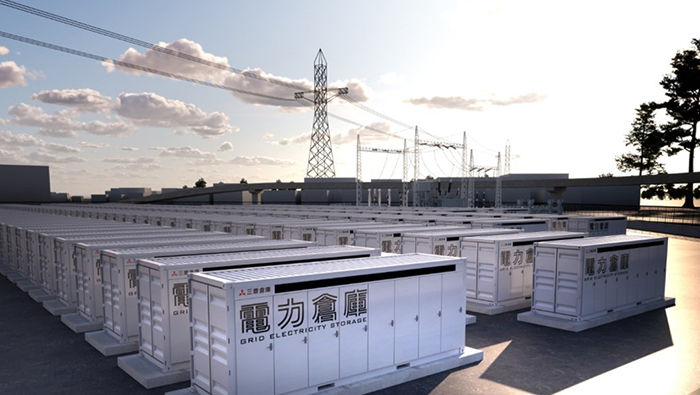
Mitsubishi Logistics Corporation announced the launch of a grid storage battery business. This new business is the brainchild of an employee. It was launched as the inaugural project of the MLC Innovation Program, which was set up in 2023 and made an open call for ideas from staff members in its search of innovation. What is a grid storage battery business? Yoshiharu Arai, General Manager of the Grid Electricity Storage Preparation Chamber, will guide you through the new venture.
Grid storage battery business: wasting no electricity, including from renewable energy
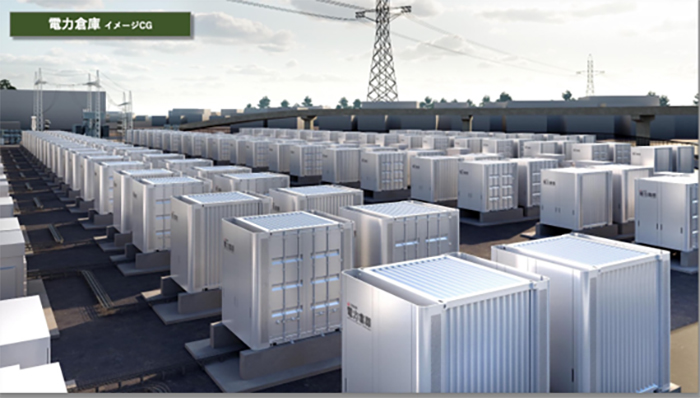
Mitsubishi Logistics Corporation’s grid storage battery business starts with installing a large storage battery in land owned by or partially leased to the company. Next, we connect the battery to a power grid. Then we engage in power trading in the electricity market (wholesale electricity market, supply and demand adjustment market, and capacity market) to raise revenue. The facility was named “Denryoku Soko”in Japanese, which literally means “electricity warehouse”
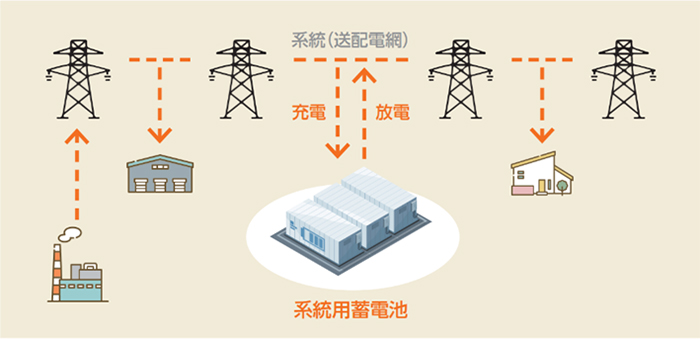
The demand and supply of electricity must be always matched and balanced. A lack of balance can result in a major blackout. Therefore, power companies regulate output in the event that electricity is oversupplied. A grid storage battery helps the steady supply of power, as the battery stores electricity during the day when there tends to be a surplus of electricity and discharges it in the evening and night when demand increases. Similarly, a grid storage battery can also store excess electricity generated from renewable sources, whose power output depends on weather conditions, ensuring that generated power is not wasted.
A veteran staff member came up with the idea: “This business would play to the strengths of Mitsubishi Logistics Corporation.”
Grid electricity storage was invented by Yoshiharu Arai, a veteran who joined Mitsubishi Logistics Corporation in 1992. Mr. Arai’s proposal was selected in the MLC Innovation Program, in which we called for proposals from all employees. Arai started working to make his idea a reality following nearly a year of training, research, and development. What inspired his idea?
“I worked with the real estate division for a long time after I left the logistics (warehouse) section. In many cases, our real estate business uses locations formally occupied by warehouses. Few warehouses, however, are “station-front properties,” requiring us to think of ways to develop them and find a tenant. Therefore, my senior colleagues came up with the idea of constructing buildings that would be similar to data centers in the present time. I engaged in a series of projects dedicated to this type of building, and learned that the data center industry was short of electricity. That was how this project started.”
Since we constructed a number of buildings used as data centers, some of our affiliated building management companies had many electrical experts, such as chief electrical engineers. Also, we had gained experience in managing high-capacity power equipment. These factors gave us a competitive advantage. Another unique strength of Mitsubishi Logistics Corporation is that it has safely, successfully developed social infrastructure for a long time through its logistics and real estate businesses. Furthermore, land for warehouses is well-suited for bringing in large storage batteries as there are wide driveways originally for containers. Mitsubishi Logistics Corporation and grid storage battery business appear to be unrelated, but in fact are a “likely” combination.
Developing into a third core business
This business will contribute to addressing electricity issues while playing to the strengths of Mitsubishi Logistics Corporation. In FY2027, Kodama Grid Electricity Storage (provisional name) in Saitama Prefecture and FY2030, in Kohoku Grid Electricity Storage (provisional name) are scheduled to begin operations. Each facility will run for 20 years (equivalent to the service life of the storage battery). The companies will develop this into our third core business after logistics and real estate.
Mr. Arai is confident about leading the business to success.
“I have engaged in a variety of projects over three decades and learned that the key to success is responding to a hidden need behind the direct demand. In this case, Warehouse business does not manufacture goods, but it is necessary for goods to be circulated. The same can be said for data centers in real estate. We are not a systems development company, but we develop infrastructure that supports those companies. Grid electricity storage generates no electricity, but is essential in addressing electricity issues, in my opinion.”
The combined capacity of Kodama Grid Electricity Storage and Kohoku Grid Electricity Storage is approximately 350 MWh, which is equivalent to the daily amount used by about 40,000 average households. The company plans to make an investment of over 40 billion yen by FY2030 to establish five more storage sites in other prefectures. The total capacity is projected to be approximately 700 MWh, equivalent to the electricity used by about 80,000 average households a day.
Interest grows among the staff. “Wow, this looks like the start of something interesting!”
Mr. Arai traveled around the country and visited the properties of the company in order to advance the business. On future prospects, he says, “I will reconsider other locations that we or our affiliates own to identify if there are any that could potentially be suited for the grid electricity storage battery business.” Furthermore, through this project, Mr. Arai feels a change within the company firsthand.
“My colleagues working onsite said to me encouragingly, ‘Wow, this looks like the start of something interesting!’ Moreover, the staff in legal, accounting, insurance, and other involved departments quickly understood when I presented the business to them for the purpose of internal procedures. Some even showed their support and provided practical advice, such as offering suggestions on how to handle things or giving me helpful material. Once again, I found my colleagues to be highly skilled and supportive. I was clearly reminded that Mitsubishi Logistics Corporation’s wealth of talent is what makes us competitive. Many of the staff members may find an in-house call for proposals too challenging. I, however, hope that as we build up practice, more will be willing to take on a new challenge.”
Through the new business, Mr. Arai was reminded of the strengths of Mitsubishi Logistics Corporation. While leveraging these, he hopes that the company will welcome a breath of fresh air. Mr. Arai’s innovation may be a case in which the logistics industry creates a stir in the power industry. We can’t wait for the first day of operations.
INTERVIEWEE
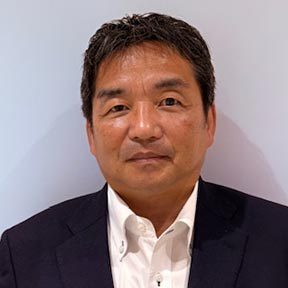
Yoshiharu Arai
General Manager of Grid Electricity Storage Preparation Chamber
Mitsubishi Logistics Corporation
19-1 Nihonbashi, 1-chome, Chuo-ku, Tokyo
Mitsubishi Logistics Corporation was founded in 1887. It has expanded its businesses globally while adapting to industrial and societal changes and contributes to society and people’s lives in the areas of logistics and real estate. The Purpose of the company is “Supporting Today, Innovating Tomorrow.” This manifests the company’s will and determination to strive to continue creating social values farther into the future, a role it has played throughout its history.