
2026.03.19

What is Boosting Sales of Mitsubishi Heavy Industries’ Emergency Generator?
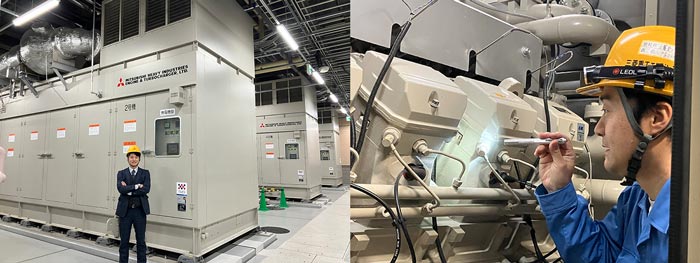
For the past few years, Mitsubishi Heavy Industries, Ltd. (hereinafter referred to as “Mitsubishi Heavy Industries”) has been enjoying a doubling in sales of its emergency generators. This sales growth is said to stem from a global trend. What trend is it?
Currently, emergency generators are reportedly popular selling products at Mitsubishi Heavy Industries. An emergency generator is like an unsung hero; it is, as its name indicates, used to obtain power for a regular power source in times of emergency. Generally, you may not come across an emergency generator in daily life, although you may picture a small one used in a food stall at a festival.
It isn’t hard to imagine that Mitsubishi Heavy Industries’ emergency generators are primarily designed for large buildings or factories. If you are to find out what has contributed to the sudden upsurge in sales, given what has been making headlines, and by gut feeling, the first thing that comes to mind may be a power outage event caused by a natural disaster such as an earthquake or flood.
Statistical data published by the Cabinet Office and the Ministry of Land, Infrastructure, Transport and Tourism shows that the occurrence of heavy rains and flooding is in long-term decline, while damage caused by isolated heavy rains jumped in some years and the occurrence of landslides are increasing as localized heavy rain has become more frequent in recent years.
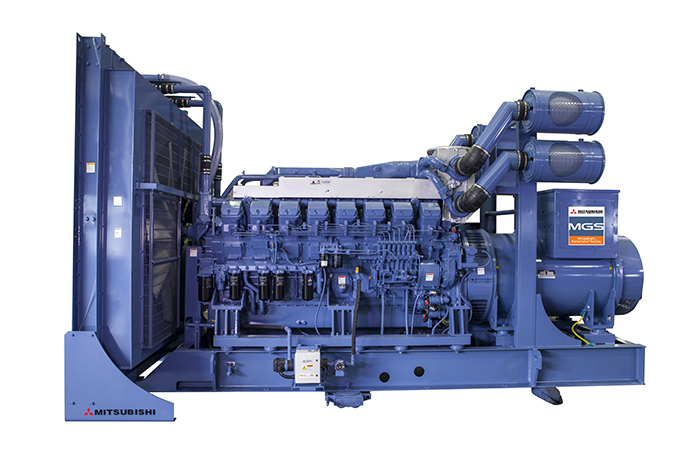
Mitsubishi Heavy Industries’ emergency generator
If this is the case, natural disasters do not seem to be a factor in the sales increase. Then, what would be the cause? Kyosuke Nomura of East Japan Sales Group, East Japan Business Department, Power Systems Division, responsible for sales of emergency generators at Mitsubishi Heavy Industries Engine Systems, Co., Ltd., answers as follows:
“In fact, emergency generators that are particularly popular at present are those designed for data centers. Sales of this type are rapidly on the rise among global data center operators. These generators are capable of generating a large amount of electricity. While, normally, a couple of emergency generators are installed in an average building, more than ten units, or in some cases over twenty in a single data center location are required. This is why the number of units sold has doubled. Given this, it isn’t hard to imagine sales soaring ten to twenty-fold. Judging from the global environment, we project that this upward trend will continue for the time being.
Data Centers Operate 24 Hours a Day, 365 Days a Year
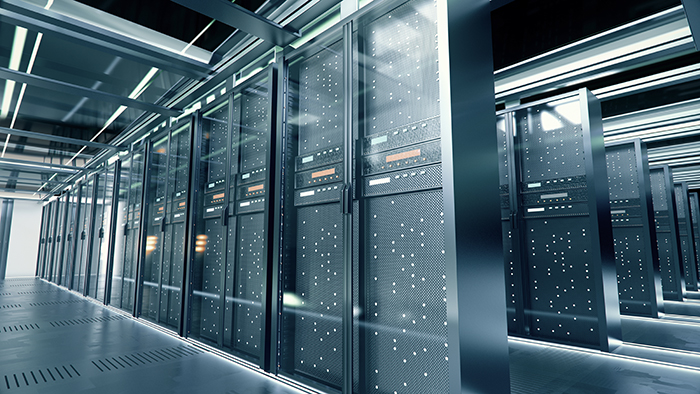
Data centers process a large amount of data
A data center is a facility designed exclusively for storing and processing a large amount of data in a safe and stable manner, constituting the “heart” of the internet and cloud services. Demand for data centers is rapidly increasing and the scale is expanding with recent advancements in DX and AI technologies.
Data centers operate nonstop 24 hours a day, 365 days a year. They understandably use a large amount of electricity. It is imperative to equip data centers with an enormous battery and a power generator to keep their operations going in the event of a power failure. Data centers are susceptible to high temperatures, requiring powerful cooling facilities. It is also critical to take precautions against earthquakes and fires.
It is said that one emergency generator unit per server is necessary at data centers. Therefore, data centers require many emergency generators. Demand is additionally so strong at Mitsubishi Heavy Industries that an exclusive team for emergency generators has been launched. Areas with firm ground tend to be chosen to build data centers. Therefore, in Eastern Japan, data centers are often concentrated in Chiba Prefecture and Hokkaido.
The Fire Services Act requires installation of emergency generators in order to ensure that essential electric devices such as illuminated exit signs and sprinklers are supplied with electricity. The need for emergency generators, which are capable of supplying electricity for longer times, increased after the Great East Japan Earthquake in 2011, in order to keep air conditioning on and protect those who are affected by disasters in a blackout. Recently, mainstream models are able to generate power for 72 hours, which is no longer considered exceptional nowadays as businesses and organizations state the measures they take against potential disruption to their business operations in their Business Continuity Plans. Besides data centers, the need for emergency generators has arisen and grown stronger over time at giant distribution warehouses that, with automated transportation systems, operate for 24 hours.
Regular Maintenance is Essential for Emergency Generators.
Ensure Performance Checks as Recommended by the Manufacturer
Emergency generators are indispensable for many companies. However, they have weakness, too; they are vulnerable to water. To avoid exposure to water, of late, many emergency generators, which used to be installed in building basements, are now installed on rooftops, just like the exterior unit of an air conditioner. In Tokyo, many emergency generators are used in office buildings, commercial establishments, hospitals and factories. Diesel engines, which are used to produce electricity, are quick to start and fuel is easy to store. They have an advantage over gas, as they can be used even in the event of an emergency.
Normally, they may go unnoticed because they are usually placed in locations that remain out of sight.
Hirohide Kodama of the After Sales Service Group, East Japan Business Department, Power Systems Division adds:
“Emergency generators need maintenance at all costs. Normally, we visit sites for periodical maintenance once or twice a year or when a problem occurs. In addition, parts and oil must be replaced once every four years and an overhaul must be performed once every eight years. We want inspections to be carried out as recommended by the manufacturer at all costs as a precaution.”
It is expected that high demand for emergency generators will continue. We must not forget that emergency generators support a variety of infrastructure, such as large commercial establishments built in the process of urban redevelopment, hospitals that save human lives and data centers that protect vital information, all of which enable society to function. We use electricity every day as a matter of course. Keep in mind, though, that emergency generators and these professionals who maintain them are the ones that we must rely on in an emergency.
INTERVIEWEES

KYOSUKE NOMURA
East Japan Sales Group
East Japan Business Department
Power Systems Division
Mitsubishi Heavy Industries Engine Systems Co., Ltd.
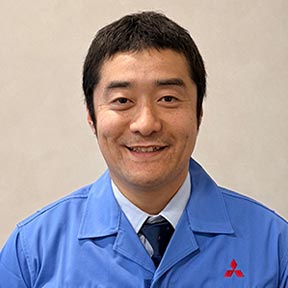
HIROHIDE KODAMA
After Sales Service Group
East Japan Business Department
Power Systems Division
Mitsubishi Heavy Industries Engine Systems Co., Ltd.
Mitsubishi Heavy Industries Engine Systems Co., Ltd.
Tamachi Tower 15th Floor
5-33-11 Shiba, Minato-ku, Tokyo
Established as a group company of Mitsubishi Heavy Industries. Its business activities include the sales, execution and service maintenance of power generation systems, industrial engines and turbocharger and related products. Emergency generators fulfill their roles by supplying electricity to hospitals and senior living facilities that protect human lives, and data centers that support the digital society, etc., when power distribution fails due to disasters, preventing loss of these functions from and supporting social infrastructure.