
2026.05.21

Mitsubishi Nagasaki Machinery Mfg. Co., Ltd. to Build New Plant for Floating Offshore Wind Power in Nagasaki City
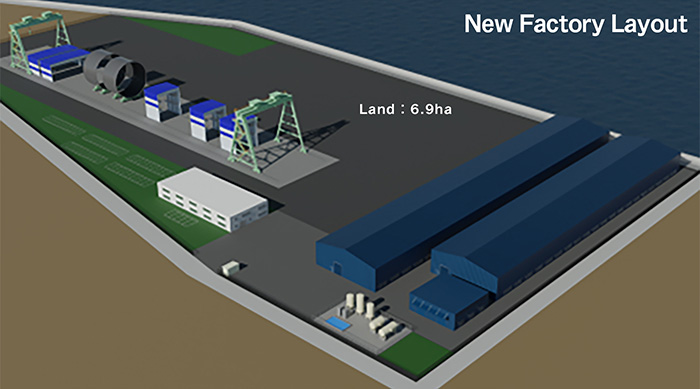
Mitsubishi Nagasaki Machinery Mfg. Co., Ltd. (hereinafter referred to as Mitsubishi Nagasaki Machinery), one of the affiliates of Mitsubishi Steel Mfg. Co. Ltd. (hereinafter referred to as Mitsubishi Steel), will build a new plant that primarily manufactures components for floating offshore wind power. The company, which turned 50 years old last year, aims to meet the need for offshore wind power, which is becoming larger, and for fortifying defense infrastructure.
Mitsubishi Nagasaki Machinery, Mitsubishi Steel's group company, is set to build a new plant to manufacture components for floating offshore wind power in Nagasaki City. Floating foundations that serve as a base supporting the operation of wind turbines will be produced at this plant. Approximately 3 billion yen will be invested in the first phase. Together with investment in the second phase, the total investment will amount to 4.6 billion yen, representing the largest investment the company has ever made. An external crane yard housing a 150‐ton crane and a plant building are scheduled to begin operations in December 2026 and summer 2027, respectively.
Mitsubishi Nagasaki Machinery has been manufacturing components for offshore wind power since 2016. In Japan, demonstration experiments for offshore wind power are currently underway in some prefectures, including Akita and Aomori. Mitsubishi Nagasaki Machinery successfully delivered the floating foundation for Goto Floating Wind Farm, Japan's first floating offshore wind farm which has been operational since January 2026, located in the offshore area of Goto City, Nagasaki Prefecture. Presently, floating offshore wind power is trending towards becoming larger to increase the efficiency of power generation. The establishment of the new plant is aimed at following this trend.
The new plant will be constructed on the premises of the oceanfront Kaminoshima Industrial Park in Nagasaki City. It is a convenient 15‐minute drive from the head office and has a land area of 69,000㎡, which is nearly as large as that of the head office plant. A number of companies supporting the shipbuilding industry are found in Nagasaki City, making it easy to manufacture large components of offshore wind power. The new plant will serve as a regional hub for assembling giant components. Tsuyoshi Minetoma, Manager of the Manufacturing Department, states:
“The tower is approximately 8 meters in diameter for a 2MW offshore wind power turbine. Consistent with the global trend towards larger size, this will be brought up to anywhere between 15 to 20 MW going forward. The cranes owned at the plant at our head office can lift components weighing up to 180 tons. It is difficult to make anything bigger than this. In addition, we want to enhance the capacity to meet the growing needs of defense-related areas.”
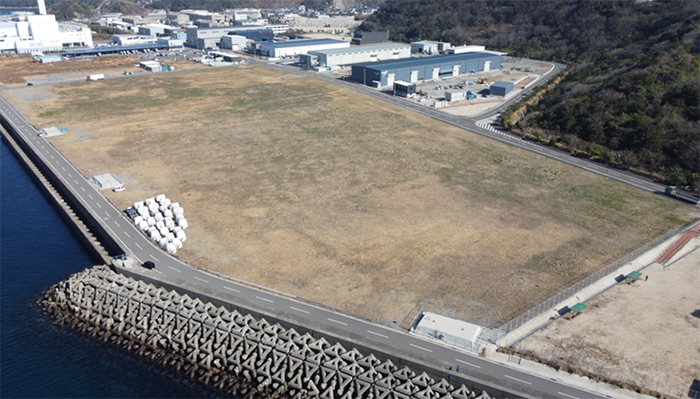
The site as of January 2026
Floating Offshore Wind Power will Become Larger
To begin with, there are two types of offshore wind power: a fixed foundation and a floating foundation. The former, in which turbines are fixed to the ocean floor with a support structure, is used in shallow coastal waters between 10 meters to 60 meters deep, while the latter is used in deeper waters. Japan does not have many locations where the structures can be fixed to the seabed because there are few water bodies that are shallow, or less than 60 meters deep, for a certain distance from the beach.
Against this backdrop, a spar‐type floating offshore wind turbine was employed for the offshore area of Goto City that is more than 100 meters deep. The spar‐type turbine is characterized by a long floating cylindrical hull that is placed vertically with ballast at the bottom to make the center of gravity low, providing high stability in deep waters. It is a huge platform; the height from the edge of the tallest blade to the bottom of the platform is approximately 176 meters, and the weight is around 3,500 tons. It may help you to understand how heavy it is if you compare the turbine with a large patrol boat owned by the Japan Coast Guard, which is similar in weight.
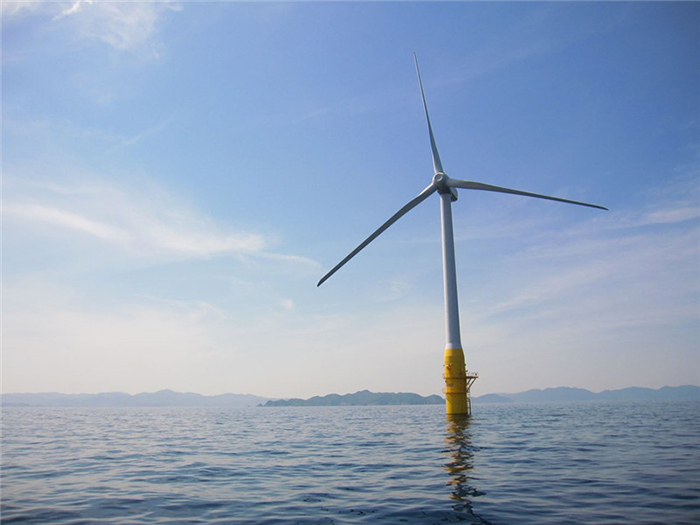
(c) 2019 Goto City.
The wind turbine is as long as approximately 60 meters from the rotational axis in the center to the surface of the water and approximately 76 meters under the water. The base of the floating structure is made of steel and concrete, making it highly stable. The floating wind turbine is designed to come back to its original position no matter how wide it sways side to side or back and forth, as its center of gravity is in the lower part of the body, like a roly-poly toy. In the event of a typhoon, it turns parallel to the wind direction so that it does not stand against the wind and stops rotating. The “floating” type can be installed in a deep offshore area, preserving the landscape and minimizing impact on everyday life that can be caused by the noise of the turbines.
“There are many kinds of offshore wind power. While there is a growing trend towards larger turbines, few companies in Japan are capable of handling them, and the scale is exceeding what any single company can manage. We also are working hand in hand with other companies to enhance our capability to tackle this larger-scale offshore wind power and boost our competitiveness.” (Minetoma)
Creating More Jobs in the Prefecture, and a Consortium with Partner Businesses on the Horizon
Mitsubishi Nagasaki Machinery had its 50th anniversary in 2025. The company was preceded by Mitsubishi Steel Nagasaki Steel Works, which originated from Mitsubishi Shipbuilding & Engineering Nagasaki Steel Works established in 1919. In 1975, Mitsubishi Steel Nagasaki Steel Works spun off into Mitsubishi Nagasaki Machinery, with the Industrial Machinery Division and the Steel Fabrication and Machining Division serving as the company’s main operation entity. The company has been in operation up to the present day.
The new plant will produce components for floating offshore wind power and meet robust demand resulting from an increase in the defense budget. At the same time, it will house a test site for a magnetic separator to be used for recycling. By having a production base in Nagasaki City, the company’s birthplace, it plans to form a consortium with partner companies in and outside the prefecture. In parallel, it intends to help more young citizens land jobs, which is a local challenge. Tsutomu Murayama, Director, states as follows:
“Both offshore wind power and defense have room for further growth. We want to maintain our focus on these areas and use the vast land housing the new plant for other purposes as well, including doing things that existing plants cannot. We want to broaden the scope of our business and enhance our growth potential right here in Nagasaki.”
INTERVIEWEES
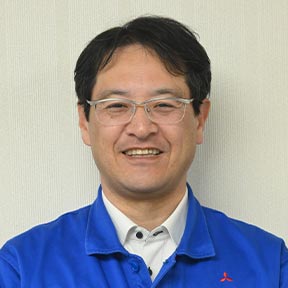
TSUTOMU MURAYAMA
Director and Senior Executive Officer
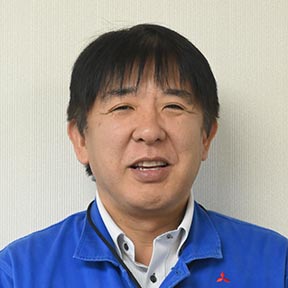
TSUYOSHI MINETOMA
Manager of Manufacturing Department
Mitsubishi Steel Mfg. Co., Ltd.
16-13, Tsukishima 4-chome, Chuo‐ku, Tokyo
Founded in April 1917 and established in December 1949, the company started manufacturing steel castings and forgings as Mitsubishi Shipbuilding & Engineering (presently Mitsubishi Heavy Industries) Nagasaki Steel Works. Categorized as a specialty steel maker today, the company was born from Japan's oldest spring manufacturer. It has 3,841 employees (as of the end of March 2025). Mitsubishi Nagasaki Machinery is responsible for the Group's machinery products business, and manufactures machinery concerning the environment, steel structures and industrial equipment in addition to offshore wind power equipment. The company has 350 employees. Many of the company's operational bases are located in Nagasaki City and Isahaya City in Nagasaki Prefecture.