
2026.06.18

Solving social challenges through railway technology
Mitsubishi Electric’s mobility infrastructure systems
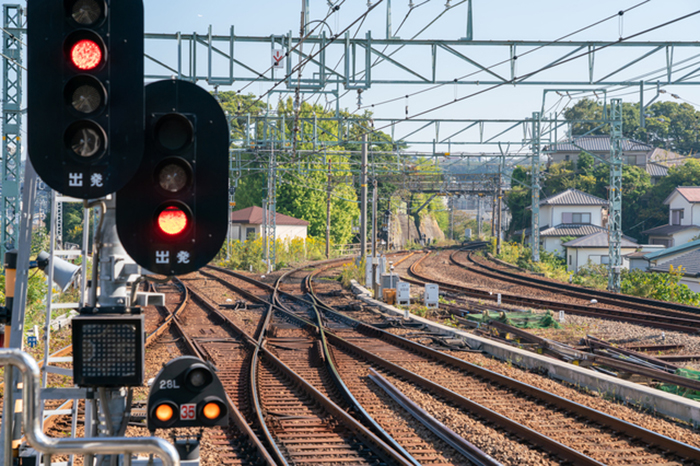
Since its founding in 1921, Mitsubishi Electric Corporation has supported Japan’s railway infrastructure for over 100 years. Now, the company has moved beyond its traditional railway business to tackle the challenges facing modern society. Ryuta Higuchi and Yuki Tamura of the Mobility Infrastructure Systems Marketing Division and Kosuke Shinji from Itami Works spoke of their passions and hopes behind the new initiative.
Mitsubishi Electric, a pillar of Japan’s railway systems, goes “beyond railways”
Since its founding, Mitsubishi Electric has worked with railway operators nationwide, including Japan Railways (JR), private railways, and municipal railways, to address the various social challenges of each era, ensuring safe and reliable transportation, boosting transport capacity, and conserving energy. In this light, Higuchi analyzes the company’s unique position.
“Our product lineup is extensive, ranging from railway vehicle electrical equipment, such as propulsion control systems (ex.: VVVF inverters), which enjoy top-tier market share in Japan, to radio communication systems, operation management systems, and power distribution equipment. We take pride in being the only manufacturer that covers all three train functions: running, stopping, and controlling.”
In Japan, trains running on schedule are taken for granted. But sustaining this “norm” requires advanced technology, and Mitsubishi Electric has consistently worked behind the scenes to deliver it.
In recent years, the challenges facing railway operators have become more complex, including severe labor shortages, achieving carbon neutrality, and enhancing the value of areas along the railway lines, challenges that cannot be resolved simply by running trains. "What is needed is a new approach that optimizes the entire social system that involves not just the railways themselves, but also the stations and towns before and after travel, operations, energy, the flow of people, as well as the passenger experience," explains Higuchi.
For this reason, the company is expanding its business beyond the traditional “railway” framework to adopt a broader perspective of “mobility infrastructure.” Expanding on the subject, Shinji explains.
"At the core of our company are the hardware components cultivated in railway environments, where extremely high levels of safety and durability are required, and the engineering expertise to integrate and implement these hardware components. Recently, we have also been focusing on digital transformation (DX) and advancing data-driven initiatives. Our new strategy links data from different infrastructure sectors, such as railways, buildings, and electricity, to create new value. We are currently in the process of implementing this in phases.”
Harnessing railway power for urban development
Energy management is at the heart of the new strategy. The company's solutions aim to address the societal challenge of achieving carbon neutrality, while eventually enhancing the value of areas along railway lines.
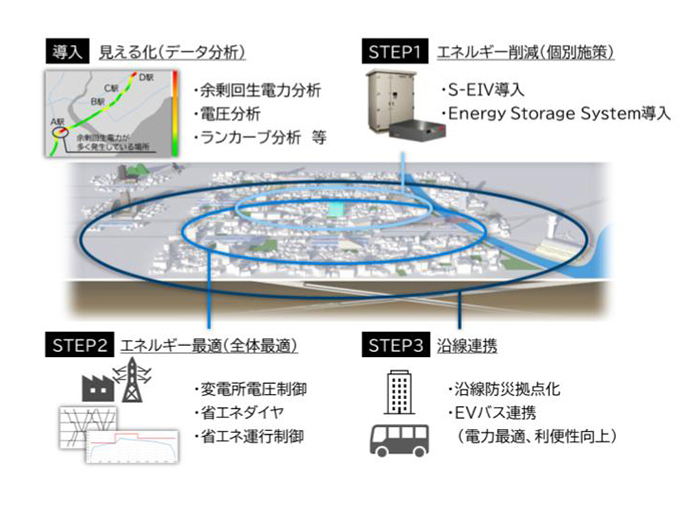
Urban Mobility Energy Solution Business
First, data is analyzed to visualize electricity waste. Next, auxiliary power supply units and storage batteries are installed in station buildings to utilize regenerative energy, achieving energy and cost savings. Further, the company will support energy management across the entire line, including railway rolling stock, substations, station buildings, and train depots, with the ultimate goal of optimizing power supply for the entire region along the railway line.
In fact, a demonstration experiment conducted with Tokyo Metro on the Yurakucho Line between Iidabashi and Shin-kiba Stations showed that optimizing substation voltage based on data analysis could reduce electricity consumption in that section by approximately 3%. “If this is implemented across the entire line or by railway operators nationwide, it would have a tremendous impact,” says Higuchi. As he suggests, expectations are high for energy saving toward carbon neutrality.
Sharing goals and taking on challenges beyond organizational boundaries
What is truly remarkable about Mitsubishi Electric is that it can deliver such an extremely complex, large-scale solution entirely in-house. The initiative all began with a casual conversation between Higuchi and Shinji a few years ago.
“Around 2024, we were in completely different fields; I was in railway vehicle electrical equipment sales, while Shinji was in ground equipment design," says Higuchi. "But we had previously worked together, and we found kindred spirits as we discussed today's social challenges and our company’s growth, agreeing that we should embark on a new business. That started everything."
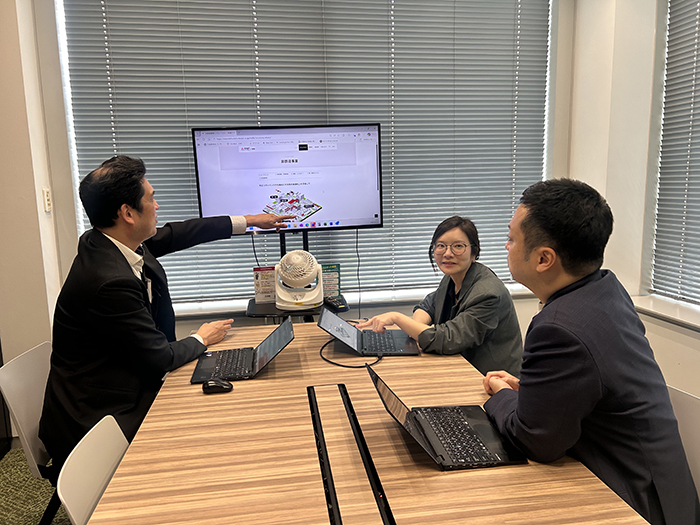
They arrived at a new business idea after daily discussions
Their initiative aligned with the company’s broader push to strengthen digital transformation. An initial small team grew into a cross-departmental organization within Mitsubishi Electric, linking Itami Works and Kobe Works, which handle manufacturing and engineering, and the Yokohama office, which specializes in data analysis.
“In our inter-department collaboration, we have put the strongest emphasis on nurturing a sense of shared purpose among participants and ensuring that all are comfortable and aligned with our vision,” says Higuchi. "Although it is not easy to facilitate cross-organizational collaboration, we hold regular meetings at least once a month, consistently sharing goals, and I have a clear feeling that we are moving forward as a united team."
Solving social issues surrounding mobility infrastructure
Beyond the railway transportation business, Mitsubishi Electric is exploring ways to apply mobility data to develop innovative solutions that address social issues. One such initiative is the food waste reduction service managed by Tamura. For instance, when service users board a train, notifications are sent to their smartphones about inventory and discounts at stores around their destination station. The service simultaneously reduces food waste at stores and enhances user convenience.
Tamura explains, “When we introduce the service at trade shows and other venues, people are puzzled and ask me why Mitsubishi Electric is tackling food waste. However, solving the social issue of food waste and providing stores with new sales channels ultimately helps elevate the appeal of the areas along the railway lines."
Additionally, as a part of efforts to establish a system supporting sustainable tourism resources, the company conducted a demonstration experiment of a “support platform" at Setouchi Triennale 2025. Fish-shaped wooden tags were sold at vending machines as an easy way for tourists to make donations; they could write a message on the tag and submit it to the organizing committee to show their support.
“By transforming places that were only a transition point into a destination you want to advocate, we can create new travel opportunities and revitalize local communities," says Higuchi. "We aim to stimulate travel demand and enhance the value of areas along the railway routes by fostering the tourism experiences that are the purpose of travel."
Taking the initiative in transforming its own image
Finally, we asked each team member about their outlook.
“Population decline and energy issues are challenges we face daily. I want to use the technical expertise we’ve cultivated over the years to solve these problems,” says Shinji.
“I want the public to know that Mitsubishi Electric is more than a ‘railway equipment manufacturer,’ and that we’re active in urban development and community revitalization along railway lines,” says Tamura.
Higuchi says, “Our strength lies in being a ‘conglomerate’ that operates in a wide range of business areas. Moving forward, we intend to harness the diverse expertise Mitsubishi Electric possesses to create new value.”
Technology that ensures railway safety and digital solutions that enrich communities. Mitsubishi Electric will continue to build on its traditions while taking on innovative challenges.
INTERVIEWEES
*Department information as of Mar. 2026 at the time of the interview.
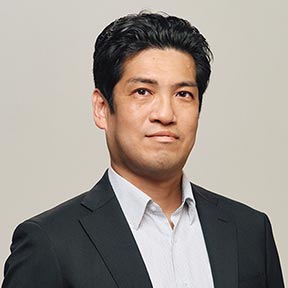
Ryuta Higuchi
Mitsubishi Electric Corporation
Mobility Infrastructure Systems Marketing Div.
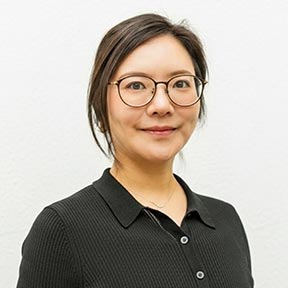
Yuki Tamura
Mitsubishi Electric Corporation
Mobility Infrastructure Systems Marketing Div.
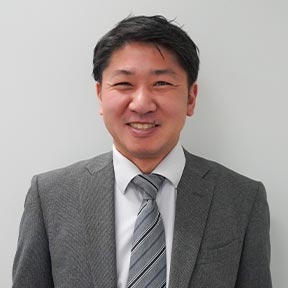
Kosuke Shinji
Mitsubishi Electric Corporation
Itami Works
Mitsubishi Electric Corporation
2-7-3 Marunouchi, Chiyoda-ku, Tokyo
(Tokyo Building)
Established in 1921, the Mitsubishi Electric Group has been guided by “Our Philosophy,” which places sustainability at the core of its management. It operates businesses in social systems, energy systems, defense and space systems, factory automation (FA) systems, automotive equipment, building systems, air conditioning and home appliances, digital innovation, and semiconductors and devices. The Mitsubishi Electric Group aims to transform into an "Innovative Company" that generates value through bold thinking and a willingness to embrace risk, driving growth and addressing social and environmental challenges.