
2026.07.16

Based on its Circular Methanol Concept,
Mitsubishi Gas Chemical Company Provides Solutions that Promote Hydrogen Use
With its proprietary technology for producing methanol-based hydrogen energy, Mitsubishi Gas Chemical challenges itself to build a new business model under its circular methanol concept.
Amid growing demand for hydrogen as an energy source, Mitsubishi Gas Chemical (MGC) leverages its own methanol business value chain, technologies, and expertise, and directs its efforts toward providing society with hydrogen solutions.
In February 2025, MGC signed a memorandum of understanding with Methanol Reformer of Spain, a manufacturer of methanol-based hydrogen generators, and Element 1 of the United States, a leader in advanced technology development, to collaborate in developing and commercializing hydrogen solutions. In August 2025, MGC began working with Fuji Electric to explore the feasibility of a demonstration project for a power generation system that uses methanol as a hydrogen carrier, with the aim of supplying hydrogen fuel cells to a wide range of regions and facilities.
Methanol has traditionally been derived from fossil fuels such as natural gas, but it can also be produced from CO2 and waste, combined with renewable energy. Methanol is emerging as a key material that enables carbon neutrality across both the material and fuel applications.
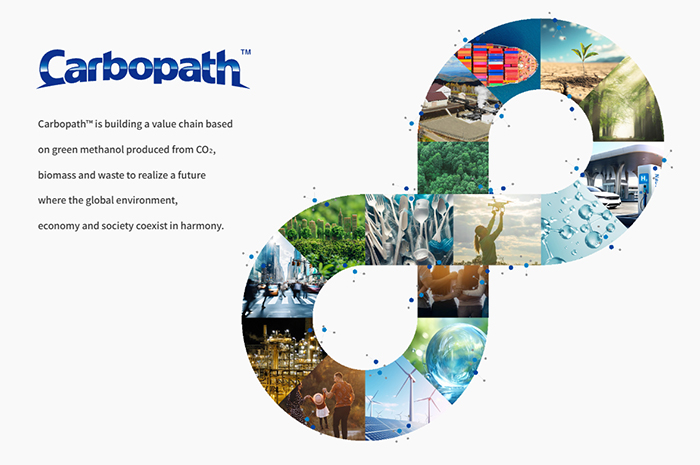
As part of its efforts to address climate change, MGC has turned its attention to methanol’s role in advancing carbon resource recycling. In 2022, the company branded this effort as Carbopath™, a combination of “Carbon” and “Pathfinder” (pioneer), to promote its circular methanol initiative. At the same time, MGC is taking steps to establish a new business model that uses methanol as a hydrogen carrier, leveraging its own technology along with the world’s cutting-edge technologies.
Promoting the Carbopath™ circular methanol concept
in which CO2 and waste plastics are converted to methanol
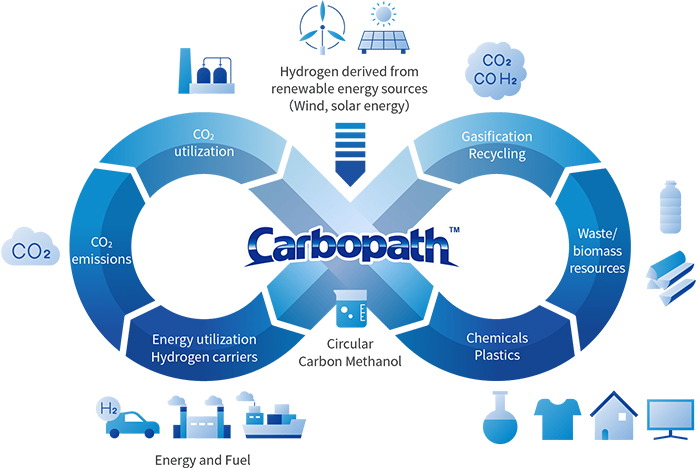
The Carbopath™ Circular Methanol Concept
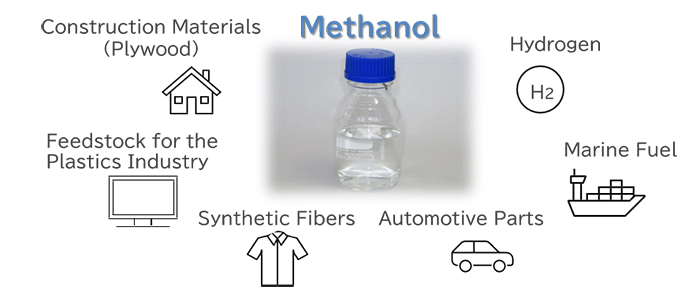
Methanol is a type of alcohol—a colorless and transparent liquid at room temperature that has a wide range of industrial applications involving a variety of everyday-use products, from plastics and synthetic fibers to automotive parts and building materials (plywood). Methanol is also a fuel source, used as a chafer fuel under small individual pots in traditional Japanese inns (ryokan) and as a fire starter for charcoal in barbecues.
MGC is the world’s only integrated methanol producer, covering every stage of the traditional methanol value chain. The combined annual production capacity of the company’s affiliated production sites exceeds 7.5 million tons. It has established a global supply network of four production facilities located in Saudi Arabia, Brunei, Trinidad and Tobago, and Venezuela.
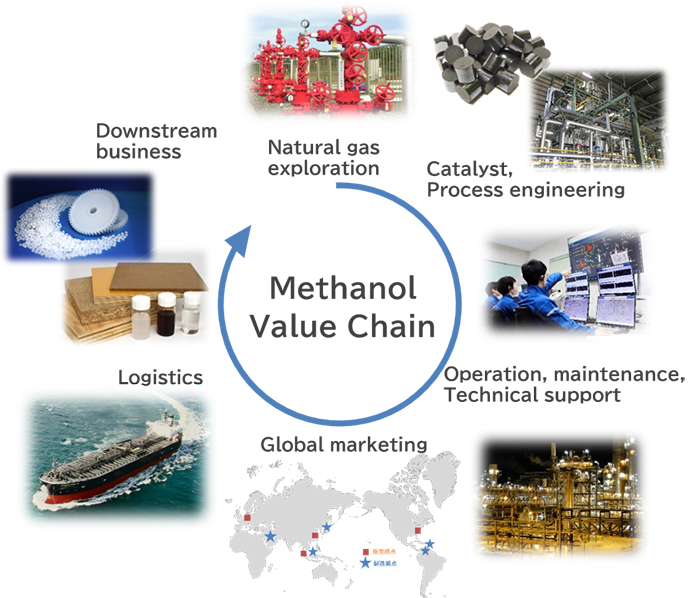
Methanol Value Chain
Over the past decade, global methanol demand has nearly doubled to approximately 100 million tons currently, of which Japan’s domestic demand accounts for roughly 1.5 to 1.7 million tons. Demand is expected to grow even faster in the days ahead, as its use is anticipated to grow as a marine fuel and hydrogen carrier. MGC has continued expanding its global and domestic methanol business since 1952, when it became the first Japanese company to produce methanol from domestically sourced natural gas using its own technology at its Niigata plant.
MGC has commercialized methanol as a hydrogen carrier (Methanol to Hydrogen: MH) since 1985, relying on its proprietary processes/catalyst technologies. The MH has been offering, for many years, an on-demand hydrogen sourcing at the customer’s location, where tackling the difficulty of hydrogen transportation and storage in a bulk amount. Toshikazu Kishi, Manager of the Carbon Neutral Project Department in the C1 Chemicals Division of the company’s Green Energy & Chemicals Business Sector, explains.
“Our hydrogen production process based on methanol reforming uses a methanol-water solution as the raw material. It is a liquid at room temperature and is easier to transport and handle than hydrogen gas. The methanol-water has a high per-unit volume capacity to carry hydrogen, and we are further expanding current hydrogen production technology, adopting the circular methanol concept to offset CO2 emissions."
In MGC’s recent hydrogen business cases, it has been delivering high-purity hydrogen across sectors such as fine chemicals, fine ceramics, and electronics (semiconductors).
In collaboration with other companies that possess technologies and products,
MGC aims to promote methanol as a hydrogen carrier
As expectations for hydrogen's role as an energy source grow, demand for methanol as a hydrogen carrier is rising due to its low barriers to implementation.
In addition, circular methanol (Carbopath™) offers a practical countermeasure for the CO2 emissions when using methanol as a hydrogen carrier. Replacing methanol with circular types will enable a gradual shift toward decarbonizing hydrogen use. In addition, methanol-based hydrogen production process allows customers to introduce hydrogen without building dedicated hydrogen infrastructure. When combined with fuel cells, the hydrogen can generate electricity. Overall, customers can enjoy on-demand hydrogen at reduced logistics costs.
"First, we are going to provide this clean energy as a stationary power source to various facilities around us that require a stable supply of electricity, including factories, ports, airports, data centers, and commercial facilities like shopping malls," Kishi continues. "We are also aiming to supply hydrogen for heating (combustion) applications in the future. Beyond its use as fuel for industrial boilers, new hydrogen applications are already emerging, including hydrogen-roasted-coffee product and hydrogen cookers such as grills and stoves. Methanol is liquid at room temperature and easy to transport, then we will be making hydrogen available at locations offering such services."
MGC aims to promote methanol as a hydrogen carrier in collaboration with other companies’ technologies and products. It also plans to explore additional hydrogen possibilities through transportable units that can be delivered by trucks. A new model of methanol-based hydrogen generator using will be installed at its Niigata plant and begin demonstration operations sometime after the summer of 2026. At the same time, the company will develop commercial models with the aim of early market launch.
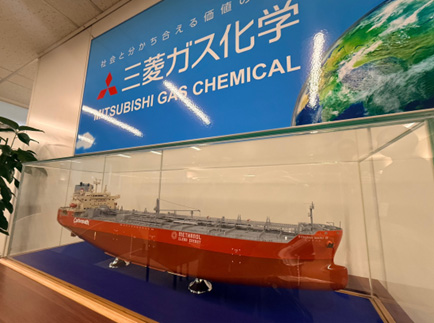
A scale model of a methanol dual-fuel ship bearing the “Carbopath™” logo adorns the reception area of MGC Headquarters.
Kishi explains that MGC is already working with various Mitsubishi Group companies to promote and advance the circular methanol concept. “The implementation of methanol as a marine fuel is now underway. In transitioning to a sustainable economy, we will accelerate our resource recycling efforts with widely used methanol as a key raw material. Our “Carbopath™” is a platform that connects everyone who is working to achieve a carbon-circularity. We look forward to collaborating closely to realize a sustainable society.”
INTERVIEWEE
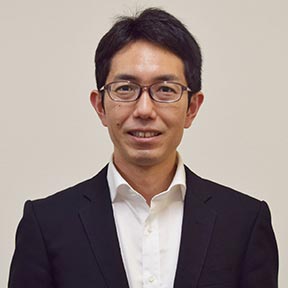
TOSHIKAZU KISHI
Manager
Carbon Neutral Project Department
C1 Chemicals Division
Green Energy & Chemicals Business Sector
MITSUBISHI GAS CHEMICAL COMPANY, INC.
Mitsubishi Building
5-2, Marunouchi 2-chome Chiyoda-ku,Tokyo
In 1971, an equal merger between Mitsubishi Edogawa Chemical Co., Ltd. (founded in 1918) and Japan Gas Chemical Co., Inc. (established in 1951) formed Mitsubishi Gas Chemical Company, Inc. Employing 8,146 people on a consolidated basis (as of March 31, 2025), it is the world’s only integrated methanol manufacturer, accounting for approximately 60% of Japan’s annual methanol imports. It holds the top global market share for products such as BT laminates for semiconductors and oxygen absorbers for food and industrial applications.