
2026.07.16

Mitsubishi Corporation Embarks on Solving Logistics Challenges
Electric Trucks Introduced to Lawson's Chilled Delivery Fleet
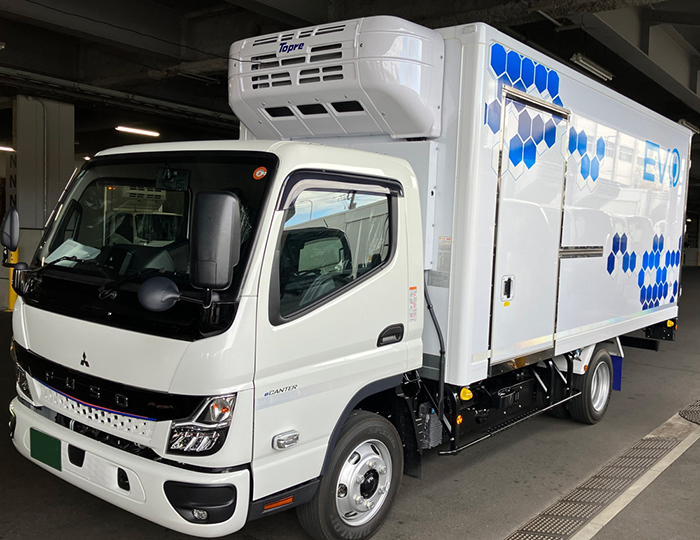
The logistics industry has yet to fully embrace EV vehicles. Eyeing the full-scale introduction of EV trucks, Mitsubishi Corporation has launched the “All Mitsubishi” initiative that ensures optimal logistics operations.
In collaboration with Mitsubishi Shokuhin, its subsidiary Best Logistics Partners (BLP), and Lawson, Inc., Mitsubishi Corporation introduced two electric trucks for chilled-goods delivery to Lawson stores starting in January 2026. In preparation, EV charging infrastructure was installed at Mitsubishi Shokuhin’s logistics hub (Kawasaki City, Kanagawa), and two “eCanter” EV trucks manufactured by Mitsubishi Fuso Truck and Bus Corporation were purchased by BLP’s logistics partner for chilled food deliveries to Lawson stores.
For EV charging infrastructure, Yourstand Inc., a startup backed by Mitsubishi Corporation, provides a one-stop service covering everything from site proposals and charger selection to installation contracting and charging operations proposals. Meanwhile, Mitsubishi Auto Leasing Corporation offers a full-maintenance lease plan for EV trucks that covers EV-specific components such as motors and drive batteries. The electricity required for driving is provided by the Carbon-free electricity plan offered by MC Retail Energy Co., Ltd., enabling virtually zero carbon emissions from charging to driving. It is expected that CO2 emissions will be reduced by approximately 35.4 tons per year.
The scheme is a collaborative effort across the Mitsubishi Group, led by Mitsubishi Corporation. Based on field test results, the group will explore expanding the EV fleet at logistics hubs. Hiroko Nakamura leads the Vehicle Electrification Team in the e-Mobility Solution Business Department at Mitsubishi Corporation's Mobility Solution Division. She explains:
“The system is operating smoothly. We started by introducing just two vehicles, recognizing that a sudden shift to electric vehicles could disrupt operations. We began the rollout at a level where we can handle any issues that might arise during the transition, such as two EVs breaking down at the same time, which is the maximum our diesel vehicles can cover.”
Will the introduction of EVs
disrupt existing operations?
The current effort aims to examine the operational challenges of EV trucks. For example, trucks serving convenience stores operate 24 hours a day, 365 days a year; their operating time doesn't consider charging time. Therefore, the challenge lies in maintaining the current delivery schedule without disruption after the introduction of EVs. Existing operation schedules are meticulously planned and difficult to alter. Operational analysis is conducted by Mitsubishi Corporation. Nakamura explains:
“Two vehicles might sound like a small change. However, we believe that while we certainly can increase the number and run theoretical calculations, we still cannot make a full-scale shift without first verifying the accuracy of those figures."
The company has considered EVs in the past. But the technology was still in its infancy at the time, and no practical implementation plan was formulated. Now, with improved EV performance and more charger options, it has decided the time is right for their introduction.
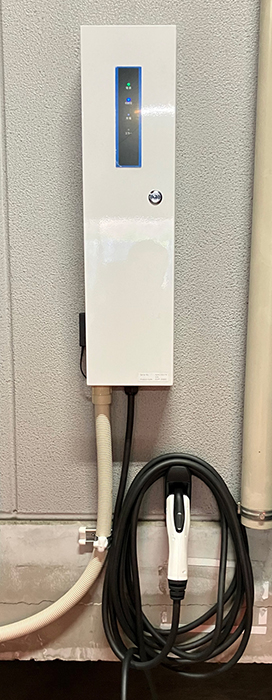
EV Charger
Unless someone takes the initiative,
no headway is possible
These days, we frequently see electric cars on the road, which suggests that electric trucks are also gaining traction. However, that’s apparently not the case.
“EV trucks themselves are very expensive to start with," says Nakamura. "On top of that, we can only purchase new ones. That’s why many logistics companies hesitate to make the switch. Although it is true that electricity is cheaper than gas, the total cost ends up high because of the vehicle price and the installation of charging infrastructure, even factoring in government subsidies.”
As for charging time, while a fast charger might take only about 30 minutes to an hour, the standard chargers introduced at this time take 3 to 5 hours. This means charging from 0% to 100% takes 16 hours. This is still acceptable only because the vehicles at the Kawasaki hub have a short daily mileage and ample time to charge. Compared to standard chargers, fast chargers have significantly higher equipment costs.
“This is exactly why our ultimate goal is minimizing costs as much as possible and finding the most sensible and optimal solution for EV operations," explains Nakamura. "We started with a couple of vehicles, but we plan to gradually increase the fleet size. It is one of the logistics challenges that the high transition cost prevents operators from taking the plunge, despite high shipper demand for the EV transition."
If no one takes the initiative, no headway is possible. By leading the initiative, Mitsubishi Shokuhin and Lawson aim to impress their EV efforts upon their shippers.
“Despite the cost increase, we believe that momentum for the EV transition will grow as operations become more established,” continues Nakamura. “EVs contribute to a better driving experience through reduced vibration and less fatigue compared to diesel vehicles. They also have superior acceleration.”
“On the other hand, achieving CO2 emissions reduction poses many challenges, and the hurdles for the EV shift are high, including vehicle introduction, charging infrastructure, power procurement, and operational optimization. To address these issues, the company offers cross-sector solutions in mobility and energy, combining EVs (Mitsubishi Auto Leasing), electricity (MC Retail Energy), and charging services (Yourstand), and promoting electrification and decarbonization of commercial mobility sectors, including logistics and taxis.”
“We also believe that our comprehensive initiatives leveraging the Group’s combined strengths can enable highly effective solutions to the challenges facing the logistics industry, such as the recent surge in fuel prices and the expected full-scale roll-out of carbon pricing.”
INTERVIEWEE

HIROKO NAKAMURA
Leader, Vehicle Electrification Team
e-Mobility Solution Business Department
Mobility Solution Division
Mitsubishi Corporation
Marunouchi Park Building
6-1, Marunouchi 2-Chome, Chiyoda-ku, Tokyo
The company was established on July 1, 1954 (Date Registered April 1, 1950). Its head offices reside at the Mitsubishi Corporation Building (registered head office) and the Marunouchi Park Building. As of April 1, 2026, the company had a total of 1,196 offices worldwide: 11 in Japan and 98 overseas (including 43 offices and the head offices of 33 local subsidiaries, as well as 22 branches). The number of consolidated companies (as of March 31, 2026) totals 1,182, comprising 833 subsidiaries and 349 affiliates and other entities. The number of employees (as of March 31, 2026) is 4,456 on a non-consolidated basis and 63,037 on a consolidated basis (employees of Mitsubishi Corporation and its consolidated subsidiaries). The company serves as the flagship of the Mitsubishi Group.