
2026.07.16

Lead, Chromium, PCBs, and Asbestos
Dai Nippon Toryo Begins Thorough Analysis of Harmful Substances in Coatings
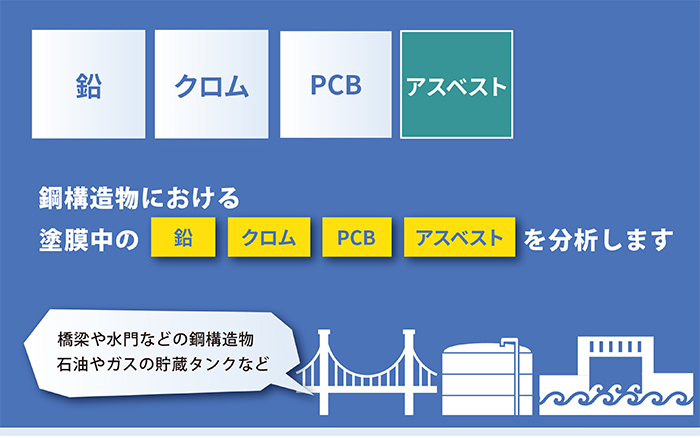
Dai Nippon Toryo, Co., Ltd. has launched a service to analyze harmful substances in coating film. The company will differentiate itself from its competitors by offering a one-stop service that combines the new testing service with paint recommendations during building demolition and renovation projects.
Dai Nippon Toryo is ramping up efforts to test and analyze hazardous substances in coating film, including lead, chromium, PCBs (polychlorinated biphenyls), and asbestos. While these substances have been used in paints in the past to improve quality and workability, they are now banned or restricted due to their toxicity, as highlighted by news reports on asbestos-related health injuries in the 2000s.
In the past, paints containing these hazardous substances were widely used on a variety of structures in various fields, including steel structures such as bridges and floodgates, as well as plant facilities in the petroleum, chemical, power, and gas industries. Therefore, when performing stripping or removal work, it is essential to dispose of the coating film in accordance with proper waste management procedures. If the preliminary survey for a demolition or renovation project indicates the presence of hazardous substances, further analysis must be conducted. Hayato Yagisawa, a member of Research Group 1’s Analysis Team in the Research & Development Department, explains:
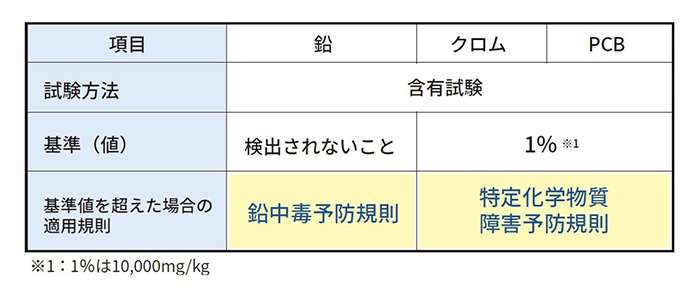
Standards for Preventing Health Impairment (Content Testing). Standards for content testing to prevent health hazards during the stripping or scraping of paints containing lead, chromium, or PCBs.
"As coating film deteriorates, it loses its appearance, and its functionality also declines. Eventually, the coating will need to be repainted, or the building will face renovation or demolition. In such cases, current stricter regulations require a preliminary survey to determine whether the existing coating contains any hazardous substances. The testing method is standardized, making it essential to engage specialized contractors like us to perform the procedure. If the presence of hazardous substances is confirmed, we must implement thorough countermeasures that ensure the protection of workers’ health and the surrounding environment.”
Mesothelioma deaths from asbestos exposure are on the rise
Dai Nippon Toryo began analyzing hazardous substances in April 2023. There are reasons for the current stricter legal regulations. Take asbestos, for example. It is a mineral composed of extremely sharp, cotton-like fibers. Because it is a mineral, it is heat-resistant and enhances the performance of paints, a highly desirable characteristic in the era of Japan’s rapid economic growth. However, if workers inhale it during demolition work, it can affect lung health, and in many cases, it has been known to cause mesothelioma, a malignant tumor originating in the mesothelium, the membrane surrounding the lungs, heart, and abdominal organs. Asbestos is believed to be the primary cause of the disease, with workers becoming ill after a long period, 30 to 40 years after exposure. About 90% of cases occur in the pleura, with shortness of breath and chest pain being common early symptoms. Since asbestos-related damage manifests after a time lag, we are about to reach the peak of this health impact.
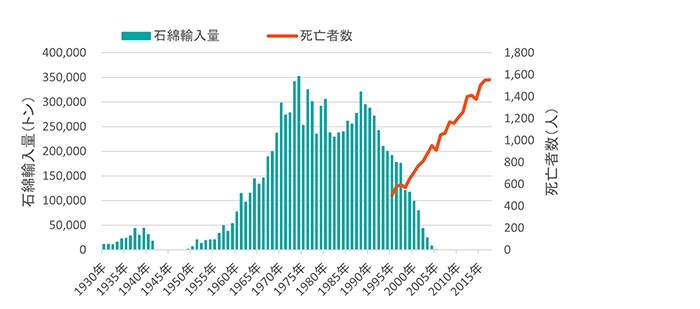
Trends in asbestos imports and mesothelioma deaths
“Since the health risks associated with asbestos began spreading, it was essentially banned under a legal amendment in September 2006 (with a complete ban taking effect in 2012)," Yagisawa explains. "However, the number of deaths from mesothelioma has been rising recently. This is because health damage from asbestos exposure manifests after a time lag. This fact also makes it important to conduct a survey to detect toxic substances prior to demolition work. During the demolition of a building containing asbestos, specialized respirators and other protective equipment are necessary to prevent inhaling asbestos fibers. The demolition site must also be enclosed to prevent the fibers from becoming airborne. In any case, the presence of hazardous substances significantly changes the safety measures required during the work.”
Choose a partner that ensures a safe and secure work site
At this time, the market for hazardous substance testing services is flooded with providers, primarily survey firms. Meanwhile, paint manufacturers propose appropriate paints during the renovation phase. Dai Nippon Toryo seeks to differentiate itself by offering a “one-stop service” that includes both preliminary hazardous substance testing/analysis and new paint proposals based on knowledge acquired from the survey.
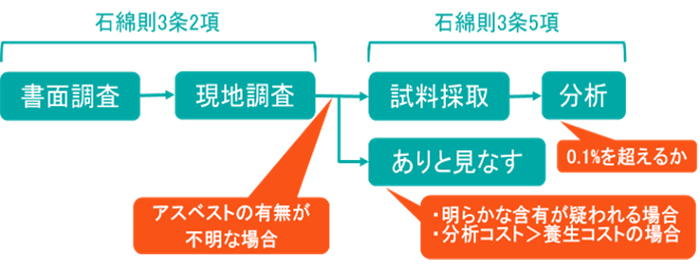
The Steps in an Asbestos Preliminary Survey
Regarding asbestos, starting in April 2021, all construction work, including demolition and renovation, must be preceded by an asbestos survey. In April 2022, it became mandatory to report to the authorities if a project exceeded a certain scale. The survey process starts with a document review, followed by an on-site inspection, and finally sample collection and analysis. In some cases, asbestos may be presumed to be present during the on-site inspection without a final analysis. Yagisawa notes that every year, the company handles an increasing number of surveys and analyses, and adds that special caution is required during factory demolition and renovation.
“Asbestos was often used for the exterior walls of factories due to its fire-resistant properties. It is highly likely to be present in factories built before enactment of the regulations. Currently, a survey is mandatory whenever such a building is demolished or renovated. We sometimes see news reports about contractors who have been referred to prosecutors for failing to conduct preliminary inspections. Awareness of asbestos is growing every year."
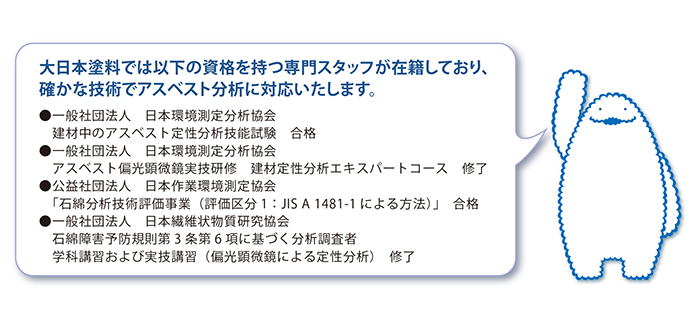
Information boards at most construction sites display the results of hazardous substance tests. When passing by such a sign, look at its contents. To prevent further damage, Yagisawa emphasizes that corporate infrastructure, such as factories, must be properly managed.
“While tight deadlines are often a priority in construction projects, we strongly encourage operators to carefully select a partner who can ensure a safe and reliable job on-site. We are committed to contributing by providing highly specialized services.”
INTERVIEWEE

HAYATO YAGISAWA
Analysis Team
Research Group 1
Research Department
Dai Nippon Toryo Co., Ltd.
SR Bldg. Nagahori, 1-18-11, Minamisemba, Chuo-ku, Osaka
Established in July 1929, the company is engaged in the manufacture and sales of coating and jet inks, and sales of different kinds of coating equipment, coating works, etc. In 1936, it acquired Asahi Lacquer Seisakusho, an affiliate of Asahi Glass Co., Ltd. (now AGC), and changed its name to Dai Nippon Toryo. It is a comprehensive paint manufacturer with the top market share for structural coatings for bridges and plants. Now known as “DNT,” it is listed on the Tokyo Stock Exchange Prime Market. The company’s strength lies in its ability to propose integrated “coating systems,” enabled by its technical capability to reduce VOC (volatile organic compound) emissions and the LCC (life-cycle cost) of structures, using heavy-duty anti-corrosion technology developed since its founding. The company employed 702 people (2,496 on a consolidated basis) as of March 31, 2025.