
2026.08.20

Mitsubishi Fuso Conducts Demonstration Test of Static Wireless Charging Methods
for Parked Small-Sized “eCanter” EV Trucks
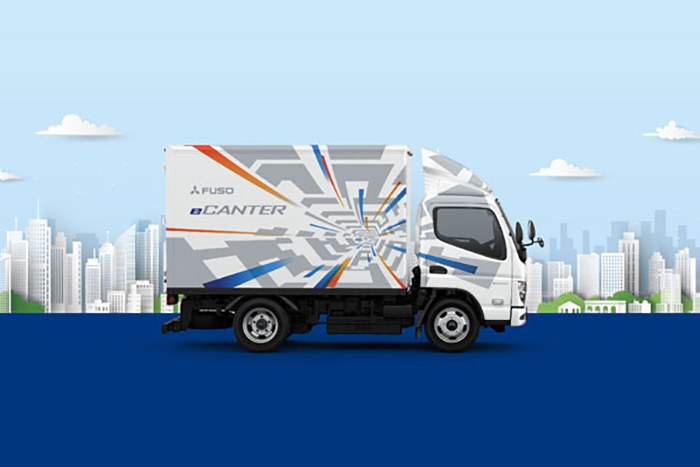
As part of exploring a variety of charging solutions to promote the use of electric trucks, Mitsubishi Fuso Truck and Bus Corporation conducted a demonstration experiment for a wireless charging system in which a vehicle is charged simply by parking it.
Since the end of 2024, Mitsubishi Fuso has been conducting a demonstration test of static wireless charging for the “eCanter” EV light-duty truck, in collaboration with Mitsubishi Research Institute, Inc. and the power equipment manufacturer DAIHEN Corporation. In late March 2026, the project moved from the preparation stage to test-run operations. The field test lasted approximately three months, ending in late June.
This demonstration project was adopted by the Ministry of the Environment’s “FY2024 Program to Promote Social Implementation of Advanced Systems for Decarbonization of the Transportation Sector.” The project aims to use the demonstration results to publish guidelines for commercial EV users and support the implementation of wireless charging systems in society.
In the experiment, Meitetsu Transportation Co., Ltd. operates an “eCanter” truck with wireless charging capabilities in actual service, charging the vehicle while it is parked at the facility. The vehicle charges for approximately six to eight hours overnight after a 50–75 km shift. Key points to be verified include the ease of installation and equipment compatibility, the user experience during operation and parking, and the safety and labor savings achieved by this cable-free system.
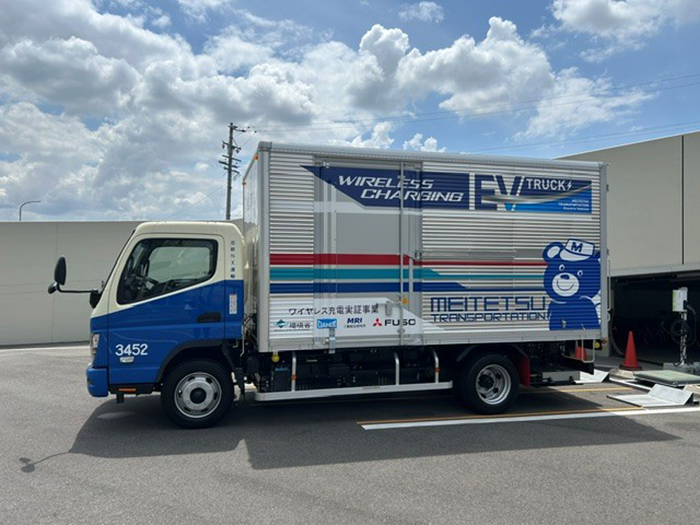
Actual vehicle used for the demonstration experiment
The company aims to identify technical and operational challenges associated with wireless charging technology in real-world operating environments. Specifically, it plans to test whether the new charging method is viable in daily operations at the Meitetsu Truck Terminal Chubu, which is located in the suburbs of Nagoya and is one of the Meitetsu Transportation bases that currently operate a total of 28 “eCanter” trucks , while at the same time assessing operational issues and on-site attitudes toward the technology.
“We have conducted a technical review to verify the system at our research lab,” says Mikihide Ozaki, Manager of Customer Success & Mobility Solutions at the company’s Mobility Transformation Division. “This time, we plan to explore key issues, such as its compatibility with logistics facilities, whether it can be seamlessly integrated into our customers’ daily operations, whether it fits smoothly into drivers’ daily routines, and if there are specific benefits to using a wireless system.”
Wireless charging systems enable
more flexible planning of charging spaces
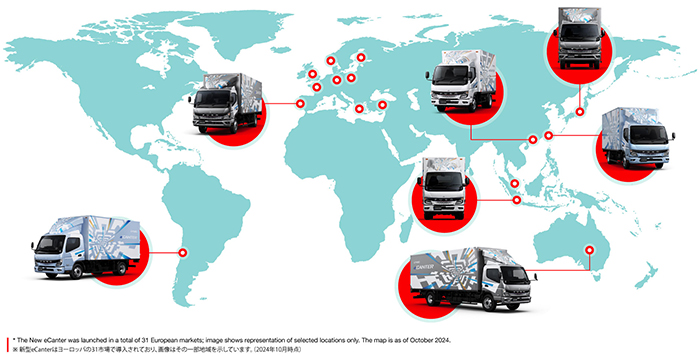
eCanters around the world
Launched by Mitsubishi Fuso in 2017, the “eCanter” is Japan’s first mass-produced electric light-duty truck. In addition to emitting no greenhouse gases and contributing to CO2 reduction, the quiet, low-vibration characteristics of electric trucks enable more comfortable urban transportation and make late-night and early-morning deliveries easier for drivers. Since 2023, the company has been actively expanding sales both domestically and internationally, including to 31 European markets, the Oceania region, Asian regions such as Indonesia and Taiwan, and the Middle East and South America.
In rolling out the eCanter, the company is focusing on developing an ecosystem that supports its introduction and continued use. Diversifying charging solutions and improving user convenience are particularly important in this effort.
Ozaki notes: “We recognize that there are certain limitations to the way we can use electric vehicles. The driving range on a single charge is limited, so we examined the issue from various angles, such as where to charge the vehicle and whether we can offer charging solutions tailored to our customers' needs.”
Wireless charging is a technology that enables charging a vehicle’s battery simply by parking the vehicle, without the need for cables required in conventional charging equipment. For eCanter vehicles, a power-receiving coil is installed and connected to the vehicle’s battery. The electricity generated by the wireless-charging equipment is sent through its power-transmitting coil to the vehicle’s power-receiving coil, which charges the vehicle’s battery.
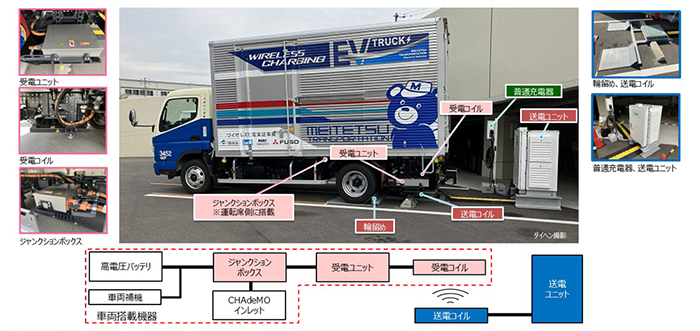
Configuration of a wireless charging system. Source: Daihen Corporation
Compared to conventional charging infrastructure, wireless charging systems allow for more flexible planning with regard to charging spaces. They also increase user convenience by eliminating the need to plug and unplug charging cables, and improve safety and efficiency by removing the need for cable management. Takafumi Kikuchi, who also works in Customer Success & Mobility Solutions under the Mobility Transformation Division, explains:
“Customers use trucks in a variety of ways. Also, trucks come in all kinds of sizes, and deciding where to install the battery is surprisingly difficult. Many challenges can only be understood after actually trying to park the vehicle, such as the difficulty in aligning the charging coil with the power transmission coil. These processes are allowing us to become keenly aware of the real challenges of product development. We hope to clarify more practical operational challenges and issues related to truck use cases through this demonstration test.”
Throughout the demonstration test,
Mitsubishi Fuso gains insight for the future
Mitsubishi Fuso provides comprehensive support for the introduction and operation of the eCanter through its “FUSO e-Mobility Solutions” program, and the current demonstration test is part of that framework. The company will enable customers’ flexible use of eCanters by rolling out a wide range of eCanter charging solutions.
In promoting the use of electric trucks, battery capacity (energy storage), which determines driving range, will be a key challenge. To allow operators to plan routes without needing to consider the fact that electric vehicles are involved, it is essential to diversify and further improve charging solutions. Beyond workplace charging, options such as en-route charging and dynamic charging, which automatically optimize charging speed and power consumption, should be explored.
“While the ultimate form of wireless charging is power transmission while the vehicle is in motion," says Ozaki, "regarding trucks, the issue is varying degrees of applicability in use cases, and the question is how to best leverage the benefits of EVs. Once again, diversifying charging solutions may be the most realistic solution.”
Passenger cars, taxis, buses, and trucks vary significantly in terms of vehicle class and body structure because of their intended use. When considering wireless charging, a specific use case must be identified and necessary features and specifications adjusted accordingly. At this stage, the company is still evaluating charging technology and assessing its basic applicability. Going forward, a more concrete approach will become necessary to examine what is needed beyond charging capabilities, including specific features and specifications required for each charging space.
“I hope to work hard and give it my all during the demonstration test period and gain experience and knowledge that help to shape insight for the future,” says Kikuchi.
At the end of the interview, Ozaki sent the following message:
"Four companies collaborated to carry out the demonstration test, and it has been deeply rewarding to work together on this next step in cutting-edge technology. We look forward to continuing the collaboration through these partnerships to bring new technologies to market. Cross-industry collaboration beyond auto manufacturers is essential for creating new forms of mobility. As a member of the Mitsubishi Group, we hope to continue working with all of you in various ways.”
INTERVIEWEES

MIKIHIDE OZAKI
Manager,
Customer Success & Mobility Solutions
Mobility Transformation Division

TAKAFUMI KIKUCHI
Customer Success & Mobility Solutions
Mobility Transformation Division
Mitsubishi Fuso Truck and Bus Corporation
10 Ohkura-cho, Nakahara-ku, Kawasaki-shi, Kanagawa
A core member of the Archion Group, a holding company established through the business integration of Hino Motors, Ltd. and Mitsubishi Fuso Truck and Bus Corporation, Mitsubishi Fuso Truck and Bus Corporation is a commercial vehicle manufacturer headquartered in Kawasaki City. The company develops, manufactures, and sells FUSO-brand trucks, buses, and industrial engines in approximately 170 markets worldwide. The company is actively engaged in the development of advanced technologies, including electrification through Japan’s first mass-produced electric light-duty truck, the “eCanter,” and the implementation of Level 2-equivalent advanced driver-assistance technology in its “Super Great” heavy-duty truck, a first for a commercial vehicle in Japan.