
2026.08.20

Mitsubishi UFJ Asset Management Establishes Intelligent Solutions Division
to Strengthen Its AI and Digital Initiatives
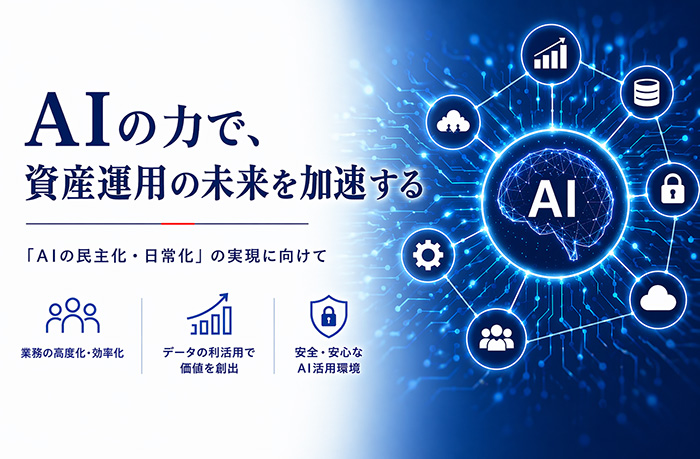
In January 2026, Mitsubishi UFJ Asset Management Co., Ltd. established the Intelligent Solutions Division, dedicated to formulating strategies and plans for AI and digital technologies and promoting their use. With this establishment, the company aims to strengthen its company-wide AI and digital initiatives while developing specialized talent.
The division currently has about 30 employees, including those who hold other positions concurrently. The newly appointed division head, Yusuke Seki, who previously led the IT Planning and Management Division, explains:
“Since around 2022–2023, when ChatGPT rapidly gained traction, the IT Planning and Management Division has been leading various initiatives to determine the best ways to leverage AI for our business. Going forward, we will position AI as a strategic function in its own right rather than simply as part of IT, and accelerate AI adoption across the company.
More and more companies are using AI. Across industries, companies are establishing digital departments apart from traditional IT departments and actively promoting AI adoption, particularly for digital transformation (DX).
“Currently, most companies are pursuing digital transformation simultaneously through AI and data. We also hope to create a new trend by strengthening our AI and digital capabilities.”
AI transformed from a technology for a select few
to a tool for everyone
These days, the number of AI-related news reports is also increasing. For example, security concerns have been raised about “Mythos” (officially known as Claude Mythos), developed by U.S.-based Anthropic in April 2026. Mythos is a cutting-edge AI model specialized in detecting and analyzing software vulnerabilities, with advanced reasoning capabilities that far surpass those of human experts in identifying security flaws. Its public release has been postponed due to the extremely high risk of its exploitation in cyberattacks.
“In addition to AI and data management, our division handles cybersecurity models like Mythos,” Seki continues. “This area also requires specialized expertise. In the world of cybersecurity, both attackers and defenders are utilizing AI, accelerating technological advancements.
There is no doubt the field of AI is evolving at a rapid pace. It was only a few years ago that the pros and cons of generative AI, such as ChatGPT, were being debated. Now, AI Agents that can plan and learn on their own and autonomously handle multiple tasks have become mainstream. Beyond that, discussions are already underway regarding Physical AI that autonomously perceives and assesses real-world situations and acts accordingly.
“AI has evolved from a technology used by individuals with advanced skills to a tool anyone can use,” Seki explains. “In our company, we are working to develop a work environment that encourages the effective use of AI, and we have largely achieved the integration of AI in our workplace. Looking ahead, with the use of AI as a premise, we intend to further refine its roles and functions.”
Seki lists five key areas that the Intelligent Solutions Division pursues: intelligence activities, such as information gathering; introducing useful technologies to the company; supporting the application of those technologies to business operations; training specialists; and AI governance.
“We will strengthen our AI governance, and in cooperation with diverse sections within the company, we will integrate AI in our operations company-wide.”
In addition to improving operational efficiency,
the focus is on advanced capabilities that create a competitive edge
Since the company’s business is asset management, it piques the curiosity to see how the company plans to use AI in its operations.Speaking from his personal perspective,, Seki said:
“The asset management field has seen advances in machine learning and some other areas, but generative AI is likely to be used more in analysis and research operations. To streamline administrative tasks associated with asset management, we have implemented systems to improve efficiency. However, because we handle a wide variety of products in small quantities, it is often difficult to use bulk-processing systems, so a significant amount of work still requires manual processing. Meanwhile, generative AI has the potential for more nuanced decision-making and processing, which are difficult for existing systems to carry out."
Currently, the monthly AI usage rate by the company’s employees is nearly 100 percent. Looking ahead, Seki says he hopes to leverage AI to streamline operations and enable more advanced analysis that drives differentiation of the company’s products.
“We are already working to streamline tasks typically handled by individuals. Now, we want to expand the scope to include organizational processes that can be streamlined and automated." Seki continues, "We believe that we can create new value by leveraging AI to achieve what was previously impossible with existing technology.”
INTERVIEWEE
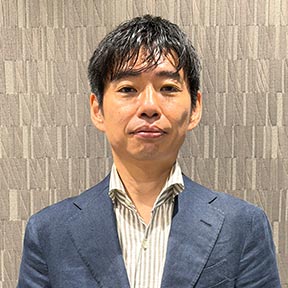
YUSUKE SEKI
Intelligent Solutions Division
General Manager
Mitsubishi UFJ Asset Management Co., Ltd.
Tokyo Shiodome Building
1-9-1 Higashi-Shinbashi, Minato-ku, Tokyo
Established in August 1985. In October 2023, the company changed its name from Mitsubishi UFJ Kokusai Asset Management to its current name, Mitsubishi UFJ Asset Management Co., Ltd. Assets under management: Investment trust, 42.1 trillion yen; discretionary investment and investment advisory, 6.1 trillion yen (as of the end of March 2025). Number of employees: 925.
Popular products include the “eMAXIS Slim All World Equity (All Country)” (nicknamed “Orkan”) and the S&P 500-linked “eMAXIS Slim U.S. Equity (S&P 500)” (Slim S&P 500). The combined number of holders for these two funds exceeds 10 million, and the net asset value of each fund amounts to 12 trillion yen. In addition to active management, the company is working to enhance its private-asset and alternative-investment sectors.