
2026.09.17

Revolutionize the Space Industry
Mitsubishi Precision Developing Integrated Navigation System for Autonomous Flight Safety
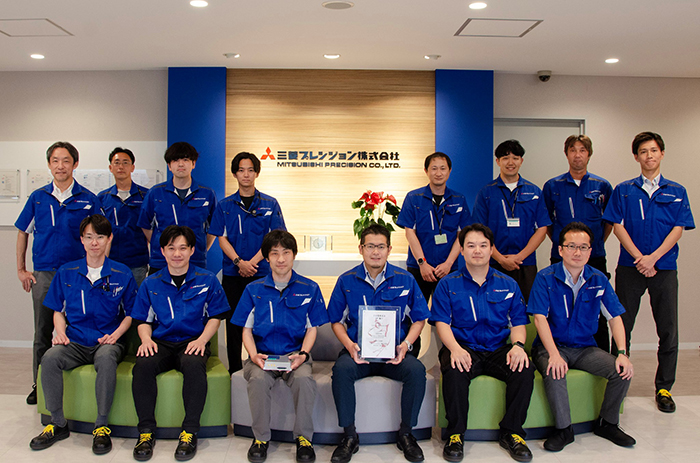
The flight termination system (FTS) is a crucial safety mechanism mounted on a launch vehicle that monitors its flight status while confirming the planned path and detects any abnormalities or risks of falling to the ground to prevent such a situation from developing into a possible accident, principally by terminating the flight. At present, this function is facing a challenging turning point.
To address this challenge, Mitsubishi Precision is promoting a project to develop equipment for a new FTS mechanism. In order to look into this topic, we interviewed two members of the project team: Takuya Yamada, project manager from the Kamakura Operations (Space Systems Department, Avionics and Space Systems Division), and Yuma Shionoiri, a representative of the headquarters, who is from the Corporate Marketing Group (Space Systems Department, Defense and Space Systems Division) and has been involved in the project from the proposal planning stage. They described the progress of the ongoing project and future outlook.
Shift to autonomy, key for supporting increasing launch frequency
The project, which started in December 2024 after being selected for the Space Strategy Fund Program hosted by Japan Aerospace Exploration Agency (JAXA), is to develop “integrated navigation system for autonomous flight safety.”
Previously, until around 2015, rocket launch projects unavoidably involved large ground facilities, which contained a radar station to track the vehicle’s flight path and location to transmit commands from the ground, an essential means to ensure safety. However, maintaining a radar station is prohibitively expensive. To address this issue, launch service providers began to adopt Global Navigation Satellite System (GNSS)-based navigation sensors to enable a vehicle in flight to be tracked by providing something like a “smart tag,” thus eliminating the need for a ground radar station.
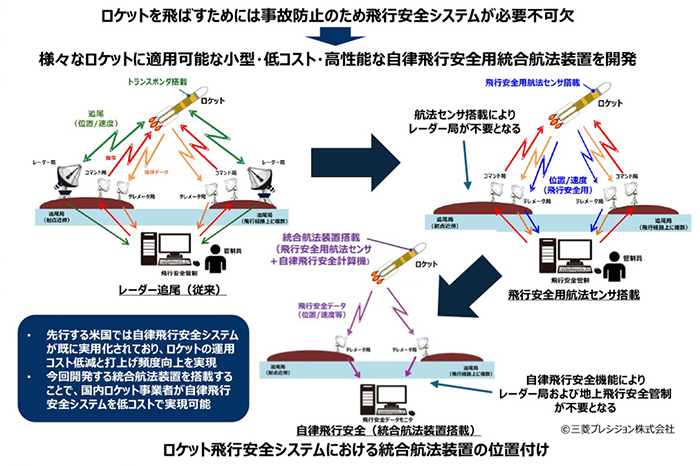
Role of integrated navigation system in the context of FTS development
The new tools enabled the automatic location of a target vehicle. Yet, it still needed a ground station to monitor safety and send commands to a rocket in flight. In this context, space development technology is stepping into a more advanced stage to implement an autonomous flight termination system (AFTS). Yamada explained the significance of this technology.
“In the past, if an abnormality occurred with a rocket in flight, human personnel on the ground decided to terminate the flight, as needed. AFTS enables the rocket to make a termination decision on its own accord. Recently, rocket launch frequency has been growing significantly to respond to both public and private sector needs, exceeding the capacity of JAXA’s existing ground stations. Therefore, it is vitally important to establish AFTS functionality in order to promote future space development activities.”
Downsizing and cost reduction to accelerate the development of the space industry
The primary highlight of this project lies in its aim of integrating two different functions―navigation sensor for location and AFTS―to be housed in a single unit, as opposed to the standard structure of those functions contained separately in independent components. Yamada described the benefits of the integrated structure.
“An integrated structure allows a significant size and weight reduction. This can achieve units in sizes suitable to be mounted on miniature rockets produced by start-ups. And a lighter unit means it consumes a smaller share of the satellite payload capacity, which helps reduce launch costs.”
Another notable characteristic of the project is its pursuit of general versatility, by striving for a design that can accommodate various types of launch vehicles. Taking this approach, the project is challenging the traditional concept of space equipment for rocket launch that each item is a unique product designed solely for a specific vehicle, and looking to address the issue posed by the resulting costly tailor-made production orders. The plan is to promote a versatile design to substantially reduce the development period and cost for application to individual vehicles. In addition, the design aims to adopt as many mass-produced commercial components as possible in a bid to decrease the cost of equipment production, by up to half, compared to a traditional order for a custom-engineered equivalent. Given the rapidly growing number of miniature rocket producers in Japan, downsizing and cost-cutting are key to increasing the competitiveness of the country’s space industry as a whole.
Meanwhile, the team is faced by various challenges in carrying out the pioneering project. In particular, the team had a lot of difficulties with incorporating many different concepts and specification requirements collected from each producer into a single equipment design. Yamada shared his feelings about that situation.
“To achieve a good specification layout for the development design, we listen carefully to many customers and other stakeholders while trying to strike a balance. It is very challenging and interesting at the same time.”
Shionoiri also talked about difficulties associated with the new grant scheme.
“The Space Strategy Fund Program is a new experience for both Mitsubishi Precision and JAXA, as it was a new research grant scheme launched by JAXA and we were a first-period applicant. As such, we faced a myriad of difficulties dealing with documentation requirements and reporting milestones while trying to make the best possible submissions through trial and error to overcome the situation of lacking good reference cases for everything. We have also identified problems difficult to solve only with our existing knowledge of the space industry, and are striving to overcome each in close contact with customers.”
Combining proven track record and flexibility of young talent
This challenging project is being driven by two key engines: confidence as an engineering company based on our extensive track record in providing rocket equipment products to support Japan’s space industry; and dynamism stemming from the energetic young employees. The two interviewees presented their analysis of the company’s strength for the purpose of promoting the project.
“Our strength comes from the balanced way of promoting two contrasting elements―solid tradition and flexibility. The former is related to the company’s proven track record in the field of navigation sensors and a wealth of knowledge of traditional development techniques, which is backed by its history of being engaged in the space development industry since its earliest days. The latter is provided by a number of young team members in their 20s and 30s, good out-of-the-box thinkers responding effectively to new development methods planned by business ventures.” (Yamada)
“From our experience of many years, I’m aware of the importance of having firm relationships of trust with JAXA and various rocket companies. It is a valuable asset. Thanks to this, we have established a common language to share a common understanding of issues to solve.” (Shionoiri)
Concentrating on the moment of a lift-off
A flagship launch vehicle, used principally to transport satellites, requires several years to develop, and flies to complete its mission of sending a satellite into orbit, generally in several tens of minutes from launch. Mitsubishi Precision devotes its energies to this fleeting event.
“Equipment development work involves long-term steady and persistent efforts, as well as pursuit of absolute reliability that will never fail, which is extremely difficult. Yet, being committed to a successful rocket launch, an enormously thrilling moment, I feel this is a challenge worth the effort. I hope the project will successfully commercialize the integrated navigation system for AFTS and contribute to increased rocket launch frequency. Nothing else would make me happier.” (Yamada)
“A rocket development project takes at least four or five years to create a prototype and develop it into a complete product ready for service. This process is accompanied by piles of work for administrative arrangements and schedule coordination, which must be completed before enjoying the memorable moment of witnessing a successful launch event. That moment gives a thrill worth all the effort. We should work to further contribute to society by demonstrating our unique strength as one of the few companies engaged in the space business in the Mitsubishi Group. I believe the ongoing integrated navigation system development project will play a key role in promoting activities to this end.” (Shionoiri)
INTERVIEWEES
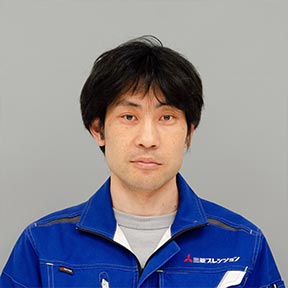
TAKUYA YAMADA
Space Systems Department, Avionics and Space Systems Division, Kamakura Operations
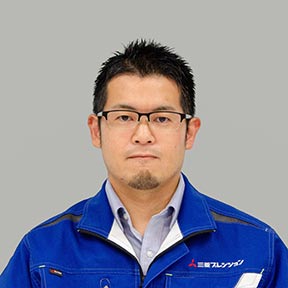
YUMA SHIONOIRI
Space Systems Department, Defense and Space Systems Division, Corporate Marketing Group
Mitsubishi Precision Co., Ltd.
Shibaura Crystal Shinagawa 8F, 1-6-41 Konan, Minato-ku, Tokyo
Established in 1962 to engage in the design and manufacturing of flight simulators and navigation systems. Today, the company conducts business centered around the three sectors of electronics and navigation systems, simulation systems, and parking systems, while committing to social infrastructure improvement with the aim of realizing a safe, secure and comfortable society in the future.